Ratha Yatra: Lord Jagannath's Chariot Festival
The Day the Lord Steps Out to Meet Everyone
Quick Facts
- Festival:
- Ratha Yatra, the Chariot Festival of Lord Jagannath, Lord Balabhadra, and Devi Subhadra
- When Observed:
- Asadha Shukla Dwitiya, the second day of the bright lunar fortnight of the month of Asadha, usually falling in June or July
- Central Figures:
- Lord Jagannath, Lord Balabhadra, and Devi Subhadra; 550 years ago witnessed in ecstasy by Sri Chaitanya Mahaprabhu; served by King Prataparudra
- Location:
- Jagannath Temple to Gundicha Temple, along the Bada Danda (Grand Road), Puri, Odisha — a journey of roughly 3 kilometres
- Core Teaching:
- Ratha Yatra festival observed by Sri Chaitanya Mahaprabhu is the emotional process of taking Krishna back to Vrindavan, since Srimati Radharani had refused to go with Krishna to Dwaraka's royal opulence
- Connection to the Series:
- Ratha Yatra day itself follows Pahandi and Chhera Pahara, already covered in this series, and precedes the deities' stay at the Gundicha Temple and Their return in Bahuda Yatra
Introduction
Once Pahandi has carried the deities to Their chariots and Chhera Pahara has been completed, one thing remains before Ratha Yatra truly begins: the ropes are pulled, and Lord Jagannath, Lord Balabhadra, and Devi Subhadra move down the Grand Road of Puri toward the Gundicha Temple. This is the event the entire festival is named for, and it is the day Krishnadasa Kaviraja Gosvami gave an entire chapter of Sri Chaitanya-charitamrita to describe in detail. Ratha Yatra is not only a temple ritual. It is the one day of the year the deities leave the sanctum altogether and travel through the open streets, and it is the pastime during which Sri Chaitanya Mahaprabhu’s own dancing is recorded as having amazed the Lord of the universe Himself.
"You are the same Krishna, and I am the same Radharani. We are meeting again in the same way We met in the beginning of Our lives. Although We are both the same, My mind is still attracted to Vrindavana-dhama." — Sri Chaitanya-charitamrita, Madhya-lila 13.126–127
What Is Ratha Yatra?
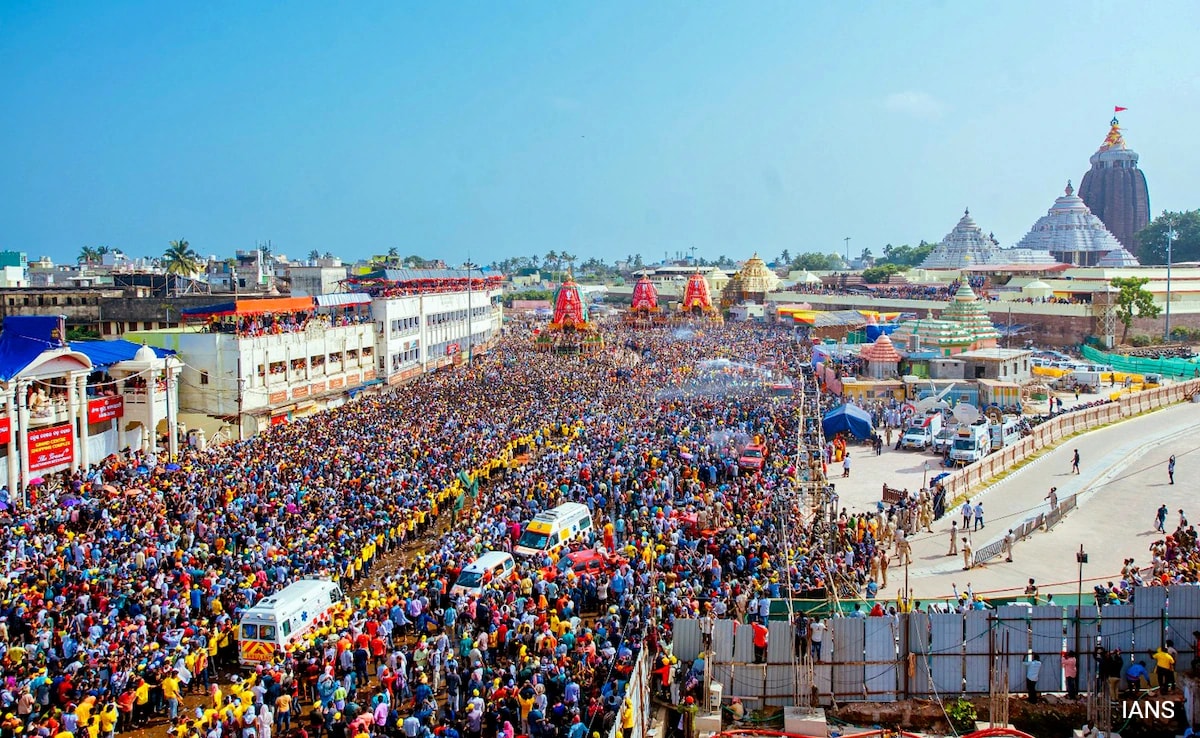
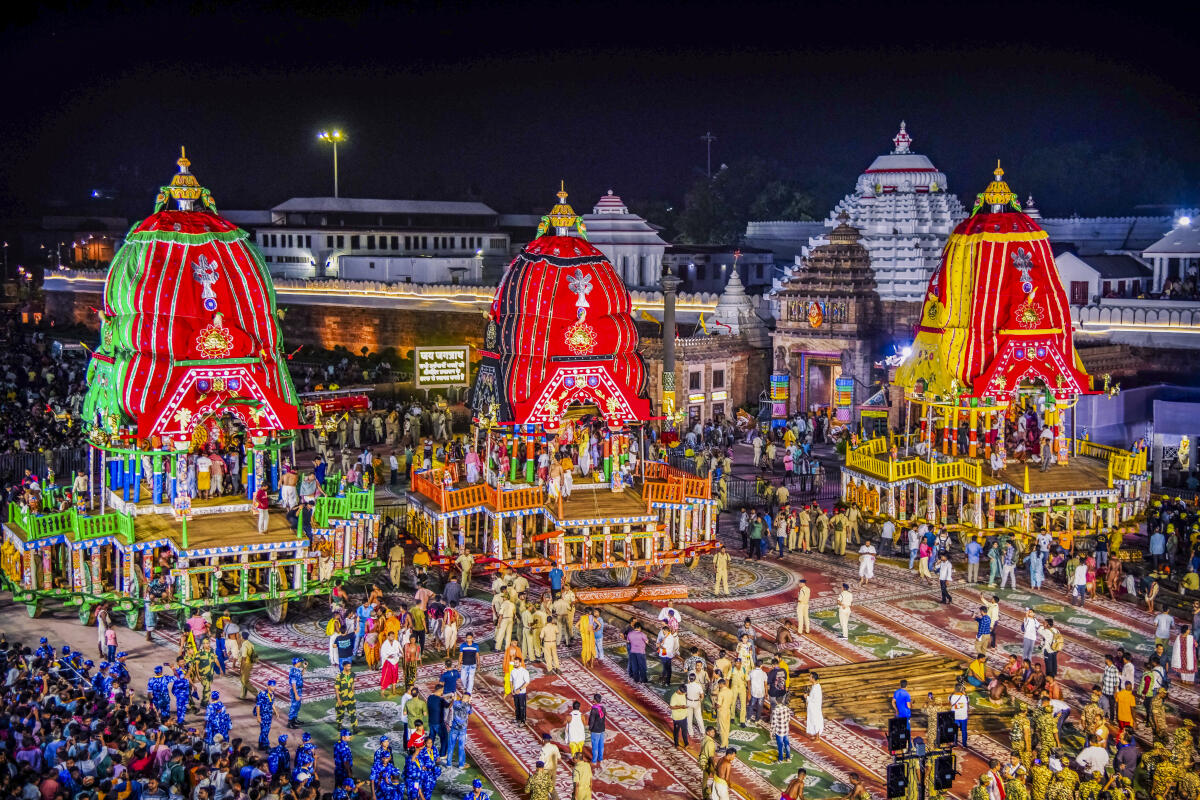
Ratha Yatra, meaning chariot journey, is the annual festival in which Lord Jagannath, Lord Balabhadra, and Devi Subhadra are carried in three massive wooden chariots from the Jagannath Temple to the Gundicha Temple, roughly three kilometres away along Puri’s Bada Danda, or Grand Road. It falls on Asadha Shukla Dwitiya, the second day of the bright lunar fortnight of the month of Asadha, and follows immediately after Pahandi and Chhera Pahara on the same morning. Each of the three deities travels in a separate chariot, newly built every year from scratch by hereditary temple carpenters, using specific woods such as phassi and dhausa, with construction traditionally beginning on Akshaya Tritiya, weeks before the festival itself. Thousands of devotees then pull each chariot forward using thick ropes, an act considered deeply auspicious in its own right.
Why Ratha Yatra Is Celebrated?
Ordinarily, the deities of Lord Jagannath remain inside the temple sanctum, which has historically been restricted to certain visitors. Ratha Yatra reverses this completely: once a year, the Lord leaves the temple and comes out into the open street, where anyone present, regardless of background, can have His darshan. This reversal, the worshipped coming out to the worshipper rather than the other way around, is at the heart of why the festival is celebrated at all. Srila Prabhupada pointed to this significance directly, teaching that simply seeing the Lord seated on the chariot carries real spiritual benefit. As he stated in a lecture given in London after the 1972 Ratha Yatra festival, quoting the verse rathe ca vamanam drstva punar janma na vidyate: by seeing the Lord on the chariot, one makes advancement toward ending the repetition of birth and death.
The Three Chariots
Quick Facts
- Deity:
- Lord Jagannath
- Height:
- ~45 ft (45 ft square at wheel level)
- Wheels:
- 16 (7 ft diameter each)
- Cloth Colour:
- Red and yellow
- Flag / Symbol:
- Trailokyamohini
- Charioteer:
- Matali
- Guardian:
- Garuda
- Wooden Pieces Used:
- 832
- Pulling Rope:
- Shankhachuda Nagini
Quick Facts
- Deity:
- Lord Balabhadra
- Height:
- ~44 ft
- Wheels:
- 14 (7 ft diameter each)
- Cloth Colour:
- Red and blue
- Flag / Symbol:
- Palm tree (Taladhwaja)
- Charioteer:
- Daruka
- Guardian:
- Narasimha and Ganesha
- Wooden Pieces Used:
- 763
- Pulling Rope:
- Basuki Naga
Quick Facts
- Deity:
- Devi Subhadra
- Height:
- ~43 ft
- Wheels:
- 12 (7 ft diameter each)
- Cloth Colour:
- Red and black
- Flag / Symbol:
- Padmadhwaja (lotus)
- Charioteer:
- Arjuna
- Guardian:
- Jayadurga
- Wooden Pieces Used:
- 593
- Pulling Rope:
- Swarnachuda Nagini
Sri Chaitanya Mahaprabhu's Ecstatic Dance
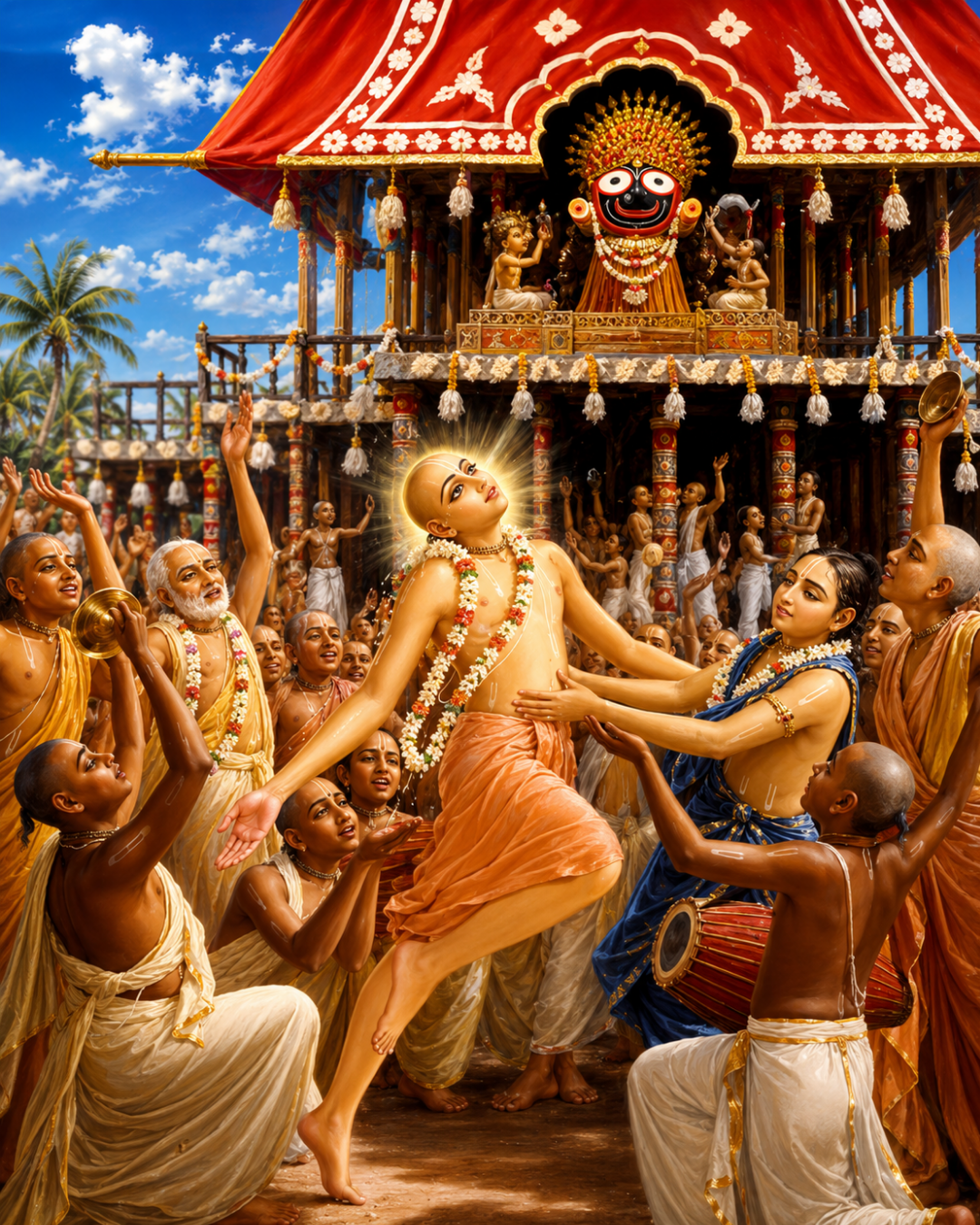
Krishnadasa Kaviraja Gosvami opens the thirteenth chapter of Madhya-lila with a verse of glorification: as Sri Chaitanya Mahaprabhu danced before Lord Jagannath’s car, not only was the whole universe struck with wonder, but Lord Jagannath Himself became astonished watching Him (CC Madhya 13.1). For the sankirtana that accompanied the procession, Sri Chaitanya Mahaprabhu first organised four core parties of kirtana performers, twenty-four chanters in total with two mridanga players each, directing Nityananda Prabhu, Advaita Acharya, Haridasa Thakura, and Vakreshvara Pandita to dance in them, with Svarupa Damodara leading the first (CC Madhya 13.33–43). Three further groups then joined from the villages of Kulina-grama, Shantipura, and Khanda, bringing the total to seven parties, positioned four in front of Lord Jagannath’s car, one on either side, and one behind, with fourteen mridangas sounding together (CC Madhya 13.44–48). Krishnadasa Kaviraja Gosvami then describes a mystic pastime: Sri Chaitanya Mahaprabhu moved through all seven parties, and each group was certain that He was dancing with them alone and had gone nowhere else, a potency the text says only the Lord’s most confidential, purely devoted associates could perceive (CC Madhya 13.51–54). Watching all this, Lord Jagannath Himself was so pleased that He brought His own chariot to a complete standstill just to see the performance (CC Madhya 13.55), and King Prataparudra, watching in turn, became so absorbed that he was converted to ecstatic love of Krishna (CC Madhya 13.56). Before beginning to dance, Sri Chaitanya Mahaprabhu is recorded offering obeisances to Lord Jagannath with folded hands, raising His face toward Him, and praying through a sequence of four verses. The first, originally spoken by Prahlada Maharaja in the Vishnu Purana, calls Krishna the worshipable Deity of brahminical culture and the well-wisher of cows, brahmanas, and the whole world (CC Madhya 13.77). The second glorifies Krishna as the son of Devaki and the light of the Vrishni dynasty, His form as soft as a lotus and His complexion like a fresh raincloud, who appeared to relieve the earth of the burden of demons and to offer liberation to everyone (CC Madhya 13.78). The third names Krishna as jana-nivasa, the shelter of all living beings, guide of the Yadu dynasty, whose smiling face forever draws the hearts of Vrindavan’s gopis (CC Madhya 13.79). Only after these three does Sri Chaitanya Mahaprabhu speak the verse for which this prayer is most remembered, declaring that He belongs to no social order at all, brahmana or shudra, student or renunciant, but is simply the servant of the servant of the servant of the lotus feet of Krishna, the maintainer of the gopis (CC Madhya 13.80). As His dancing intensified, Krishnadasa Kaviraja Gosvami records eight distinct bodily transformations of ecstatic love appearing on Sri Chaitanya Mahaprabhu at once, among them goosebumps, chattering teeth, changing complexion, perspiration mixed with what the text describes as blood, and tears flowing so forcefully that those standing near Him were wet (CC Madhya 13.101–109). One devotee, Subhananda, is recorded as having drunk the foam that fell from the Lord’s mouth during this ecstasy, considered fortunate to relish it (CC Madhya 13.110). A lighter, very human moment is also recorded during the dancing. As King Prataparudra’s attendant Haricandana tried to keep the crowd back, he repeatedly pushed against Srivasa Thakura, who was absorbed in watching the dance and did not understand why he was being jostled; when pushed again and again, Srivasa Thakura slapped him. The King himself intervened, telling Haricandana that he should feel obliged rather than offended, since he had been touched by so exalted a devotee (CC Madhya 13.90–97). The same chapter records Sri Chaitanya Mahaprabhu’s first real physical encounter with King Prataparudra. While dancing in ecstasy, the Lord stumbled and fell into the King’s arms without recognizing who had caught Him; when His associates later explained that it was the King himself, Sri Chaitanya Mahaprabhu showed a moment of mock displeasure, out of His general practice of avoiding the company of kings and politically powerful men, even as the King’s own devotion and humble service, already shown that same morning through Chhera Pahara, had genuinely moved Him (CC Madhya 13.180–188). Afterward, Sri Chaitanya Mahaprabhu circumambulated Lord Jagannath, went behind the car, and began pushing it forward with His own head. The car started moving immediately with a rattling sound, and the crowd broke into loud chanting of the Lord’s names (CC Madhya 13.189–190). He then danced in turn before Lord Balarama’s and Devi Subhadra’s cars before returning to dance again before Lord Jagannath’s (CC Madhya 13.191–192).
The Radharani Mood: Bringing Krishna Back to Vrindavan
Behind Sri Chaitanya Mahaprabhu’s outward dancing, Chaitanya-charitamrita points to a deeper, internal mood, expressed through a whole sequence of verses recited during the dancing itself, not only once. After Krishna left Vrindavan for Mathura and later Dwaraka, He was reunited with the residents of Vrindavan, including Srimati Radharani and the gopis, only once more in His earthly pastimes, at Kurukshetra during a solar eclipse gathering, as described in Srimad Bhagavatam’s Tenth Canto. That reunion carried a particular sweetness and sorrow together: joy at seeing Krishna again, mixed with the gopis’ longing for the simple, unguarded intimacy of Vrindavan, since Krishna now appeared before them as a powerful ruler surrounded by royal formality, not as the cowherd boy they had known. At one point Sri Chaitanya Mahaprabhu stopped dancing altogether, His mind having entered a mood of deep ecstatic love, and asked Svarupa Damodara to sing. Understanding His intention, Svarupa Damodara sang a refrain expressing a lover’s joy at regaining someone whose absence had left her withering away; hearing it repeated loudly, Sri Chaitanya Mahaprabhu began dancing again with even greater rhythm and bliss (CC Madhya 13.111–114). Later, His ecstasy changed again, and raising both arms, He began to recite, loudly and repeatedly, a different verse describing a lover recognising her beloved after a long separation, under the same moonlit nights and the same fragrance of flowers as before, yet still confessing that her mind longed to return to the riverbank where they had first loved one another (CC Madhya 13.120–122). Krishnadasa Kaviraja Gosvami notes that although everyone present heard Him recite it again and again, only Svarupa Damodara Gosvami understood what the verse meant in His mouth, and explains directly that this was the same mood the Vrindavan gopis had felt on meeting Krishna again at Kurukshetra, now awakened in Sri Chaitanya Mahaprabhu upon seeing Lord Jagannath (CC Madhya 13.123–125). Sri Chaitanya Mahaprabhu then spoke directly to Lord Jagannath, in words Krishnadasa Kaviraja Gosvami records almost as dialogue: “You are the same Krishna, and I am the same Radharani. We are meeting again in the same way We met in the beginning of Our lives. Although We are both the same, My mind is still attracted to Vrindavana-dhama.” He went on to contrast the two places directly: Kurukshetra, with its crowds, elephants, and the rattling of chariots, against Vrindavan, with its flower gardens and the humming of bees; Krishna dressed here like a royal prince among warriors, against Krishna in Vrindavan as an ordinary cowherd boy with His flute; and concluded that here there was not even a drop of the ocean of happiness He had shared with Him in Vrindavan, asking Krishna to return there and fulfil His ambition (CC Madhya 13.128–131). The text is candid that this was not the only verse spoken in this mood. Sri Chaitanya Mahaprabhu is said to have recited many further verses which most people present could not understand at all; only Svarupa Damodara Gosvami grasped their meaning at the time, and it was Srila Rupa Gosvami who later made that meaning known to others (CC Madhya 13.132–134). Still dancing, He recited another verse, tasted in the association of Svarupa Damodara, in which the gopis address the Lord as the only shelter for those fallen into material existence, praying that His lotus feet may be awakened within their hearts (CC Madhya 13.135–136). Speaking immediately afterward in the mood of Srimati Radharani, Sri Chaitanya Mahaprabhu said that while for most people the mind and heart are separate, His own mind was never separated from Vrindavan, so that His mind and Vrindavan were one and the same, and asked Krishna to place His lotus feet there, since He was fond of that place (CC Madhya 13.137). What follows in the text is an extended exchange in this same mood. Speaking as Radharani, Sri Chaitanya Mahaprabhu pleaded that Her home was Vrindavan and Her only wish was Krishna’s association there, rejecting the speculative knowledge and mystic yoga Krishna had once sent Uddhava to teach Her, since the gopis, already pure devotees, had no use for it (CC Madhya 13.138–142). She asked whether Krishna had forgotten Vrindavan entirely, its people, Govardhana Hill, the Yamuna, and pleaded with Him to return and let the residents of Vrindavan, dying in His absence, live again (CC Madhya 13.143–147). Krishna’s response follows: moved by this love, He said He cried day and night simply remembering the residents of Vrindavan, that Radharani was His very life among the gopis who were themselves His life among all the residents of Vrindavan, and that His absence owed only to misfortune, not to any want of love. He explained that He secretly visited Vrindavan every day by the mercy of Lord Narayana, and that once He had dealt with a few remaining enemies of the Yadu dynasty, He would return there for good (CC Madhya 13.148–158).The exchange closes with a verse in which Krishna states that devotional service alone is what draws Him back, a statement the text says finally eased Radharani’s distress (CC Madhya 13.159–160). Taken together, these verses are why Krishnadasa Kaviraja Gosvami’s chapter is read as more than a description of dancing: the temple stands in for the formality of Kurukshetra, and the Gundicha Temple, the chariots’ destination, stands in for Vrindavan itself, so that the very journey of Ratha Yatra becomes Radharani leading Krishna home. Krishnadasa Kaviraja Gosvami adds one further detail of how deeply this mood was felt: after the dancing, Sri Chaitanya Mahaprabhu would sit with Svarupa Damodara for hours, tasting these same topics, sometimes writing on the ground with His finger in emotion, until Svarupa Damodara gently held His hand back, fearing He would injure it (CC Madhya 13.161–167).
Srila Prabhupada's Teaching on This Pastime
His Divine Grace Vishwa Guru A.C. Bhaktivedanta Swami Prabhupada described Ratha Yatra as Krishna’s own festival, and pointed to Sri Chaitanya Mahaprabhu’s mood of separation during this day, the same mood exhibited by Srimati Radharani, as what makes the festival, in his words, a festival of feelings, one which gradually develops any sincere participant’s dormant love for Krishna. He also taught that the public purpose of Sri Chaitanya Mahaprabhu’s appearance was to deliver Krishna freely to everyone, without the restrictions that ordinarily apply, and that Ratha Yatra itself was the clearest demonstration of this: the Lord who is otherwise approached only within the temple comes out to be seen by everyone gathered on the open road. Srila Prabhupada also gave a direct, explicit basis for reading Sri Chaitanya Mahaprabhu’s dancing as Radharani’s mood: in Krishna Book’s account of Krishna and Balarama meeting the residents of Vrindavan, he states plainly that the Ratha Yatra festival observed by Sri Chaitanya Mahaprabhu is the emotional process of taking Krishna back to Vrindavan, since Srimati Radharani had refused to go with Krishna to Dwaraka’s royal opulence, wanting His company only in Vrindavan’s original atmosphere.
Srila Prabhupada and the Festival in the West
Srila Prabhupada’s own connection to Ratha Yatra began in early childhood, when his father arranged a small chariot for him to pull through the neighbourhood, distributing prasadam to the other children who joined him. Decades later, in 1967, he organised the first Ratha Yatra ever held outside India, on the streets of San Francisco’s Haight‑Ashbury district, using a rented flatbed truck decorated with flowers. From that beginning, the festival spread to cities worldwide, with Srila Prabhupada personally leading celebrations in San Francisco, London, and elsewhere through the early 1970s, explicitly following what he called Sri Chaitanya Mahaprabhu’s own footsteps in bringing the Lord’s festival beyond the temple walls.
Living Tradition Today
In Puri today, Ratha Yatra remains one of the largest religious gatherings in the world, with the three chariots pulled by thousands of hands along the Bada Danda toward the Gundicha Temple. The deities remain at the Gundicha Temple for about a week, during which various rituals continue daily, including Hera Panchami, when Goddess Lakshmi is said to visit in search of Lord Jagannath. On the return journey, Bahuda Yatra, the chariots make a well-known stop of their own, at the Mausi Maa Temple, where Lord Jagannath is offered His favourite Poda Pitha; that stop, and the story behind it, belongs to the return journey rather than this day, and will be covered in its own post in this series.
What stands out most from Chaitanya-charitamrita’s account of this day is how little distance the text puts between spectacle and intimacy. The same chapter that describes chariots forty feet tall, seven parties of sankirtana, and fourteen mridangas sounding at once also stops to record a single devotee drinking foam from the Lord’s mouth, and a King quietly slapped by his own attendant for jostling a Vaishnava. Grandeur and closeness are shown side by side, not as opposites. The chapter is also unusually direct about congregational chanting’s place in the festival. It does not treat sankirtana as background music for the procession; it records Lord Jagannath Himself bringing His chariot to a full stop to watch it (CC Madhya 13.55). For Gaudiya Vaishnavas, who hold congregational chanting as the recommended practice of this age, that detail carries particular weight: the text shows the Lord’s own attention going to the kirtana, not past it. Finally, the chapter does not let Sri Chaitanya Mahaprabhu’s ecstasy remain a private, unexplained event. It is anchored twice over, first in His own words identifying Himself only as a servant of Krishna’s lotus feet (CC Madhya 13.80), and second in the extended Radharani-Krishna dialogue that gives His dancing a specific, nameable mood rather than leaving it as generic rapture. Between these two anchors, humility and longing, the chapter gives readers something concrete to reflect on, not just a description of a festival to admire from a distance.
Why This Matters for Gaudiya Vaishnavas
Conclusion
Ratha Yatra is, at its simplest, one day a year when Lord Jagannath leaves the temple and comes to the street. Everything covered in this post — the three chariots and their exact measurements, the ropes thousands of hands reach for, the sankirtana loud enough to bring the Lord’s own chariot to a stop, and Sri Chaitanya Mahaprabhu’s dancing recorded centuries ago — still plays out on the Bada Danda in Puri every single year, largely unchanged. That continuity is the point: the festival still happens, drawing millions to Puri and, since Srila Prabhupada organised the first Ratha Yatra outside India in 1967, to cities worldwide. The Lord who is otherwise seen only within a temple comes out to be seen by everyone. Closing line: “Hare Krishna. Continue following the festival forward with our companion articles on the deities’ stay at Gundicha Temple and Bahuda Yatra.”