Gaudiya Vaishnava Saints · Panca-tattva Associates
Sri Sivananda Sena
The Guide of the Pilgrims
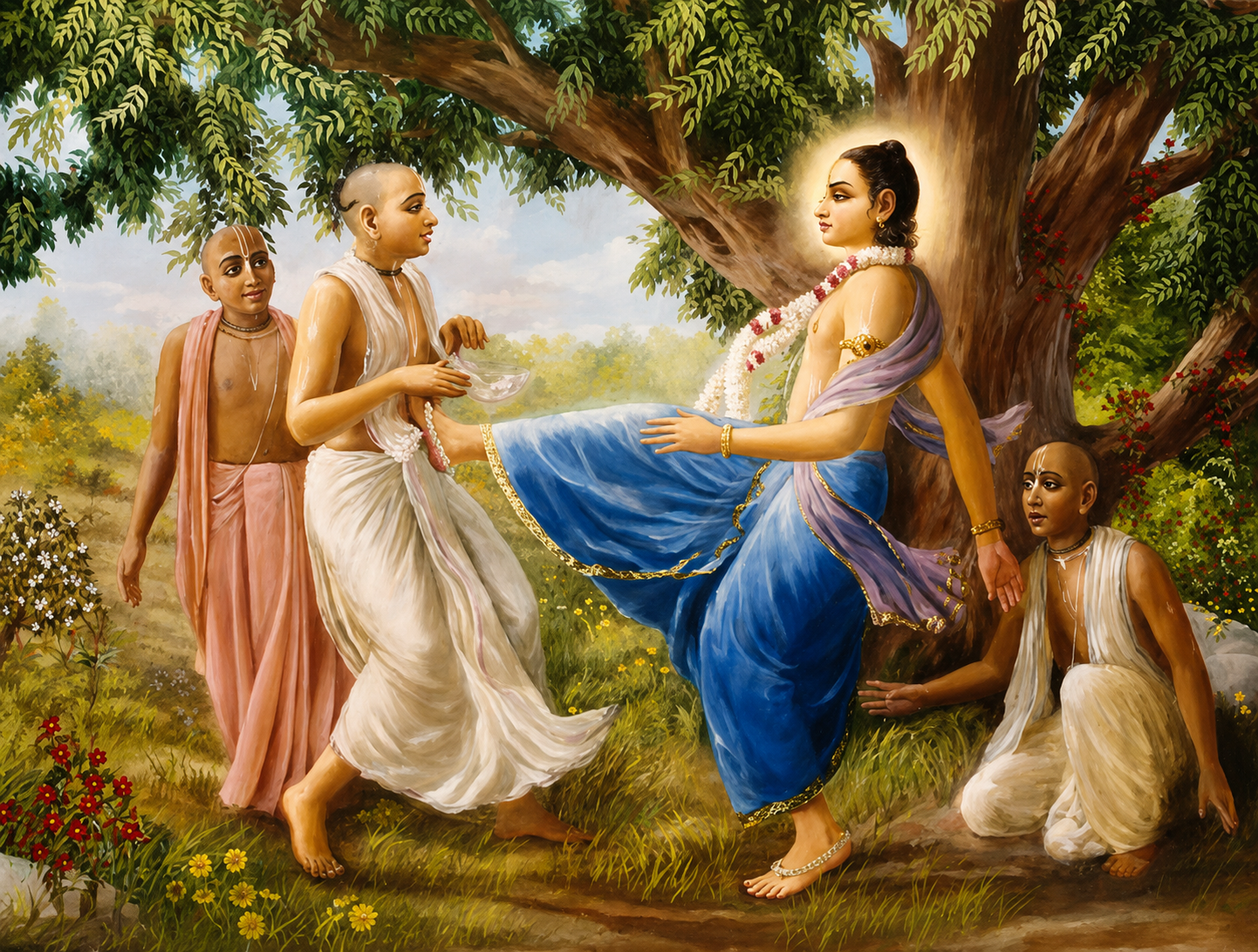 Sri Sivananda Sena, confidential servant of Sri Chaitanya Mahaprabhu
Not every devotee of Sri Chaitanya Mahaprabhu is remembered for a single dramatic pastime. Some are remembered instead for a lifetime of unglamorous, essential service, repeated faithfully year after year, without which the Lord’s other devotees could never have reached Him at all. Sri Sivananda Sena is the standing example of exactly this kind of devotion. Every single year, without fail, he personally organised, financed, and led the party of devotees travelling from Bengal to Jagannatha Puri to see Sri Chaitanya Mahaprabhu — arranging their food, their lodging, their river crossings, and the tolls along the road — asking nothing for himself except the chance to serve.
Srila Krishnadasa Kaviraja Gosvami names him among the principal branches of the great tree of Lord Chaitanya’s devotees, and Srila Prabhupada’s own translation states his position plainly:
Sivananda Sena, the twenty-fourth branch of the tree, was an extremely confidential servant.
— Srila Prabhupada, Sri Caitanya-caritamrta, Adi-lila 10.54, Translation
Quick Facts
| Full name | Sri Sivananda Sena |
|---|---|
| Residence | Kumarahatta (present-day Halisahar), West Bengal, with a second home nearby at Kanchadapada |
| Position | Twenty-fourth branch of the Chaitanya tree; extremely confidential servant of Lord Chaitanya |
| Occupation in the Lord's service | Guide, host, and logistics-manager for Bengali devotees travelling to Jagannatha Puri; manager (sarakhela) of Vasudeva Datta's household affairs |
| Wife | Accompanied her husband on the annual pilgrimage to Jagannatha Puri |
| Sons | Chaitanya dasa (eldest), Ramadasa (second), and Paramananda Sena — also known as Puri dasa or Kavi-karnapura (third) |
| Nephews | Srivallabha Sena and Srikanta Sena, both unalloyed devotees of Lord Chaitanya |
| Spiritual master | Srinatha Pandita, a disciple of Sri Advaita Prabhu |
| Incarnation of | Two gopis of Vrindavana, formerly named Vira and Duti, who combined to appear as Sivananda Sena, according to Kavi-karnapura's Gaura-ganoddesha-dipika (176) |
| Known for | Personally guiding and financing the annual pilgrimage of Bengali devotees to Jagannatha Puri; the liberation of a dog through his mercy |
Family and Background
Sri Sivananda Sena lived at Kumarahatta, also known as Halisahara, with a second family residence nearby at Kanchadapada. Srila Prabhupada, quoting the description of Srila Bhaktisiddhanta Sarasvati Thakura, records that Sivananda Sena’s spiritual master was Srinatha Pandita, a disciple of Sri Advaita Prabhu, and that Sivananda Sena himself served as the priest’s most devoted patron.
He had three sons — Chaitanya dasa, Ramadasa, and Paramananda Sena, the last of whom is far better known by his literary names, Puri dasa and Kavi-karnapura. Chaitanya dasa, the eldest, wrote a commentary on Krishna-karnamrita that was later translated by Srila Bhaktivinoda Thakura in his own journal Sajjana-toshani, and Srila Bhaktisiddhanta Sarasvati Thakura held the opinion that Chaitanya dasa, not Kavi-karnapura, was the actual author of the Sanskrit work Chaitanya-carita. Kavi-karnapura, the youngest son, was initiated by Srinatha Pandita and became one of the most important Sanskrit authors of the Gaudiya Vaishnava tradition, writing the Ananda-vrindavana-campu, the Alankara-kaustubha, the Gaura-ganoddesha-dipika, and the celebrated dramatic epic Chaitanya-chandrodaya-nataka.
Sivananda Sena’s household was not confined to blood relations alone. His nephews, Srivallabha Sena and Srikanta Sena, are named directly among the unalloyed devotees of Lord Chaitanya, and Srila Prabhupada notes that the sons, servants, and family members of Sivananda Sena together formed their own subbranch of the Chaitanya tree, every one of them a sincere servant of the Lord.
Kavi-karnapura’s own Gaura-ganoddesha-dipika (verse 176) identifies his father’s eternal spiritual identity: two gopis of Vrindavana, formerly named Vira and Duti, combined together to appear in this world as Sivananda Sena. This is a rare distinction — most devotees are described as the incarnation of a single eternal associate, but Sivananda Sena’s very person represents the union of two.
The Confidential Guide of the Bengal Pilgrims
Sivananda Sena’s central service to Sri Chaitanya Mahaprabhu was performed not in Puri itself but on the long road leading to it. Srila Prabhupada’s translation states, quite simply, that everyone who travelled to Jagannatha Puri to see Lord Chaitanya took shelter and guidance from Sivananda Sena himself.
Every year, without exception, everyone travelling from Bengal to see the Lord took shelter and guidance from him. He cleared the tax-collecting checkpoints along the route on the devotees’ behalf, arranged their residential quarters, supplied their food throughout the journey, and — because he knew the roads of Orissa thoroughly — guided the entire group safely to Jagannatha Puri. Srila Prabhupada’s translation of the Madhya-lila records his role in his own words:
He took care of all the devotees and happily traveled with them.
— Srila Prabhupada, Sri Caitanya-caritamrta, Madhya-lila 16.19, Translation
This was not a one-time act of charity but a standing yearly institution. Sivananda Sena guided all the devotees of Lord Chaitanya who went from Bengal to Jagannatha Puri, and he personally bore the entire cost of their journey — food, tolls, ferries, and lodging — for a party that traditionally numbered around two hundred devotees. His own wife accompanied him on these journeys, as did Srivasa Pandita’s wife Malini, and his son Chaitanya dasa regularly joined the party as well.
When Sri Chaitanya Mahaprabhu Himself later travelled from Bengal back toward Puri, He stopped for two days at Sivananda Sena’s own house in Kanchanapalli before continuing on to the house of Vasudeva Datta — a mark of the Lord’s personal affection for the devotee who had spent his life making that same journey possible for everyone else.
Sarakhela: Manager of Vasudeva Datta's Household
Sivananda Sena’s reliability was so well established that Sri Chaitanya Mahaprabhu Himself entrusted him with managing the affairs of another of His most beloved devotees, Vasudeva Datta, who was known to spend his wealth with such total disregard for his own future that his family’s affairs required a steady hand. Srila Prabhupada explains:
asked Sivananda Sena to become his sarakhela, or secretary, to control his extravagant expenses
— Srila Prabhupada, Sri Caitanya-caritamrta, Adi-lila 10.41, Purport
The Lord’s own instruction to Sivananda Sena on this point is recorded directly in the Madhya-lila, where He asks him personally to take charge of Vasudeva Datta’s welfare:
Please take care of Vasudeva Datta’s family affairs. Become his manager.
— Srila Prabhupada, Sri Caitanya-caritamrta, Madhya-lila 15.96, Translation
Vasudeva Datta and Sivananda Sena were, in fact, next-door neighbours their entire lives, both residents of the same area presently known as Kumarahatta or Halisahara. It is a quiet but telling detail: the Lord did not send a stranger to manage His devotee’s household, but the very neighbour who had already spent years demonstrating exactly this kind of steady, selfless competence.
The Liberation of the Dog
Among all of Sivananda Sena’s recorded pastimes, none is told by Srila Prabhupada in more loving detail than the story of the dog he encountered on the road to Jagannatha Puri. Sri Krishnadasa Kaviraja Gosvami devotes the better part of the opening chapter of the Antya-lila to this single incident, and Srila Prabhupada’s own translation preserves every step of it.
A street dog began following Sivananda Sena’s party as they travelled toward Puri, and rather than driving it away, he accepted it as one more member of the group, feeding and maintaining it exactly as he maintained the human devotees in his care. When the party needed to cross a river, an Orissan boatman refused to let the dog aboard; Sivananda Sena, unwilling to leave it behind, paid the boatman ten pana of conchshells simply to bring the dog across. Later, while Sivananda Sena was delayed at a tollhouse, his servant forgot to feed the dog, and it went missing. Srila Prabhupada’s translation records his reaction:
He then immediately sent ten men to find the dog.
— Srila Prabhupada, Sri Caitanya-caritamrta, Antya-lila 1.22, Translation
When the search failed, Sivananda Sena was so distressed that he fasted through the night, and the dog still could not be found the next morning. The whole party walked on to Jagannatha Puri in great anxiety — only to discover, on arriving, that the dog had gone on ahead of them entirely on its own and was already sitting a short distance from Sri Chaitanya Mahaprabhu, who was personally feeding it remnants of green coconut pulp and inducing it to chant the holy names of Krishna. Srila Prabhupada’s purport draws out exactly what had happened to the animal:
was immediately promoted to Vaikuntha to become an eternal devotee
— Srila Prabhupada, Sri Caitanya-caritamrta, Antya-lila 1.24, Purport
Srila Prabhupada connects this incident directly to a song of Srila Bhaktivinoda Thakura, who prayed to become nothing more than a Vaishnava’s dog — tumi ta’ thakura, tomara kukkura, baliya janaha more, from the Saranagati — precisely because even a street dog, simply by remaining in a pure devotee’s association and being maintained by his mercy, can be delivered back to Godhead. Srila Prabhupada draws the same lesson again in his purports to Srimad-Bhagavatam, using this incident as direct proof that a genuine devotee’s compassion is not selective, but extends to every living being who comes within his association, human or animal.
Protector of Raghunatha dasa Gosvami
Sivananda Sena’s trustworthiness extended even to matters of considerable delicacy within other devotees’ families. When the young Raghunatha dasa — who would later become the great Raghunatha dasa Gosvami — fled his father’s wealthy household to join Sri Chaitanya Mahaprabhu, his father, Sri Govardhana Majumadara, was naturally desperate to locate him and wrote directly to Sivananda Sena, the one person he knew would be travelling with the party to Puri and would have reliable knowledge of his son’s whereabouts.
Ten men sent by the anxious father caught up with the pilgrimage party along the road and questioned Sivananda Sena directly about Raghunatha dasa. Rather than betraying the young man’s whereabouts and delivering him back into a household he had every spiritual right to leave, Sivananda Sena simply told them:
He did not come here.
— Srila Prabhupada, Sri Caitanya-caritamrta, Antya-lila 6.182, Translation
The ten men returned home empty-handed. Only later, once Raghunatha dasa had firmly established himself at Sri Chaitanya Mahaprabhu’s side, did Sivananda Sena confirm to a further messenger from the family that Raghunatha dasa was indeed with the Lord at Puri and had become a celebrated devotee there. When Raghunatha dasa’s father finally accepted his son’s path and sent money and servants for his care, it was again Sivananda Sena who managed the arrangement, instructing the men to wait and travel with his own party rather than proceeding alone. This entire episode shows a side of Sivananda Sena’s service that goes beyond logistics and hospitality: he was trusted, by the Lord’s other devotees, to protect their spiritual welfare even against the pressure of their own families.
Feeding the Lord: The Illness from Excess Ghee
Sivananda Sena’s hospitality toward Sri Chaitanya Mahaprabhu was, on at least one occasion, almost too generous for its own good. He once invited the Lord to his home and prepared a feast cooked with such a liberal quantity of ghee that the Lord, after eating, suffered indigestion and fell mildly ill. Srila Prabhupada records the aftermath plainly:
The next day the Lord became sick and went to Murari Gupta for treatment.
— Srila Prabhupada, Sri Caitanya-caritamrta, Adi-lila 10.49, Purport
Murari Gupta, being a physician by training, gave the Lord a small amount of drinking water, which is the natural and simple remedy for indigestion, and the Lord recovered. But it was Sivananda Sena’s own eldest son, Chaitanya dasa, who first noticed what had happened and personally saw to it that the Lord was afterward given foods suited to help His digestion — a small family detail that shows the same instinct for careful, attentive service running through the whole household, not just its patriarch.
Nityananda Prabhu's Curse, and Sivananda Sena's Equanimity
On one of the journeys to Jagannatha Puri, the devotees were once forced to spend the night beneath a tree, without any shelter of house or shed. Lord Nityananda Prabhu, in an ecstatic mood of hunger, became visibly agitated at the lack of arrangements and cursed Sivananda Sena’s sons to die. Sivananda Sena’s wife, hearing this, was overcome with grief and began to weep, fully believing her sons were now doomed.
When Sivananda Sena himself returned and found his wife in tears, his response reveals the very heart of surrendered devotion — not denial of the danger, and not panic, but complete acceptance of whatever the Lord’s associate willed:
Why are you crying? Let us all die if Sri Nityananda Prabhu desires.
— Sri Sivananda Sena, quoted by Srila Prabhupada, Sri Caitanya-caritamrta, Adi-lila 10.60, Purport
When Nityananda Prabhu then saw Sivananda Sena in person, He kicked him, still complaining of hunger and asking why proper arrangements had not been made for His food — behaving, as Srila Prabhupada points out, exactly like an ordinary hungry man entirely dependent on Sivananda Sena’s care. This apparent harshness is not cruelty; it is the peculiar intimacy the Lord’s own associates share with a devotee they trust completely, and Sivananda Sena received even this rebuke without complaint.
A nephew of Sivananda Sena’s, Srikanta, could not bear to see his uncle treated this way and left the party in protest, travelling on ahead to Jagannatha Puri to see Sri Chaitanya Mahaprabhu directly. Far from taking his side against Nityananda Prabhu, the Lord pacified the boy and, on that same occasion, allowed His own toe to be sucked by the child Puri dasa — Sivananda Sena’s youngest son, later Kavi-karnapura — who was thereby empowered to immediately compose Sanskrit verses. Once the misunderstanding within Sivananda’s family had passed, Sri Chaitanya Mahaprabhu personally instructed His attendant Govinda:
they must be given the remnants of My food
— Srila Prabhupada, Sri Caitanya-caritamrta, Antya-lila 12.53, Translation
This same youngest son’s name was, in fact, chosen by the Lord Himself even before his birth — on an earlier visit, Sri Chaitanya Mahaprabhu had told Sivananda Sena in advance that when this particular son was born, he should be named Puri dasa. The bond between the Lord and this household extended even further: on a separate occasion, Sivananda Sena’s own home became the site where his devotee-friend Jagadananda Pandita prepared a large quantity of scented sandalwood oil, which was carried with great care all the way to Jagannatha Puri for the Lord’s use — a small but telling sign of how naturally Sivananda Sena’s house had become a working part of the devotees’ service to Sri Chaitanya Mahaprabhu.
“Your Affection for Me Has Always Been Great”
Among the more tender moments recorded between Sri Chaitanya Mahaprabhu and His devotees, one belongs entirely to Sivananda Sena. While the Lord was personally pointing out His devotees to Sarvabhauma Bhattacharya and others gathered before Him, He turned toward Sivananda Sena and spoke directly to him:
I know that from the very beginning your affection for Me has been great.
— Srila Prabhupada, Sri Caitanya-caritamrta, Madhya-lila 11.149, Translation
The effect on Sivananda Sena was immediate and total. Srila Prabhupada’s translation records:
Sivananda Sena became absorbed in ecstatic love and fell down on the ground.
— Srila Prabhupada, Sri Caitanya-caritamrta, Madhya-lila 11.150, Translation
Overwhelmed, he then recited a verse from the Stotra-ratna of Yamunacharya, expressing that after being submerged for so long in the ocean of material existence, he had finally reached the Lord as one reaches the shore, and that the Lord Himself had thereby found the ideal recipient of His own causeless mercy. Srila Prabhupada’s purport to this verse draws out its deeper meaning: every conditioned soul is eternally part and parcel of the Supreme Lord, struggling in the material ocean through no fault but his own forgetfulness, and the Lord is always personally anxious to rescue any soul who simply surrenders to Him — exactly as He had now, in this moment, rescued and reassured His long-devoted servant.
Deities Installed and Temples Established
Sivananda Sena’s devotion was not confined to logistics and hospitality; he was also directly responsible for establishing Deity worship that continues to this day. Srila Prabhupada, again quoting Srila Bhaktisiddhanta Sarasvati Thakura’s own description, records that Gaura-Gopala Deities were installed by Sivananda Sena himself, and that he also established a temple of Krishnaraya which still exists today.
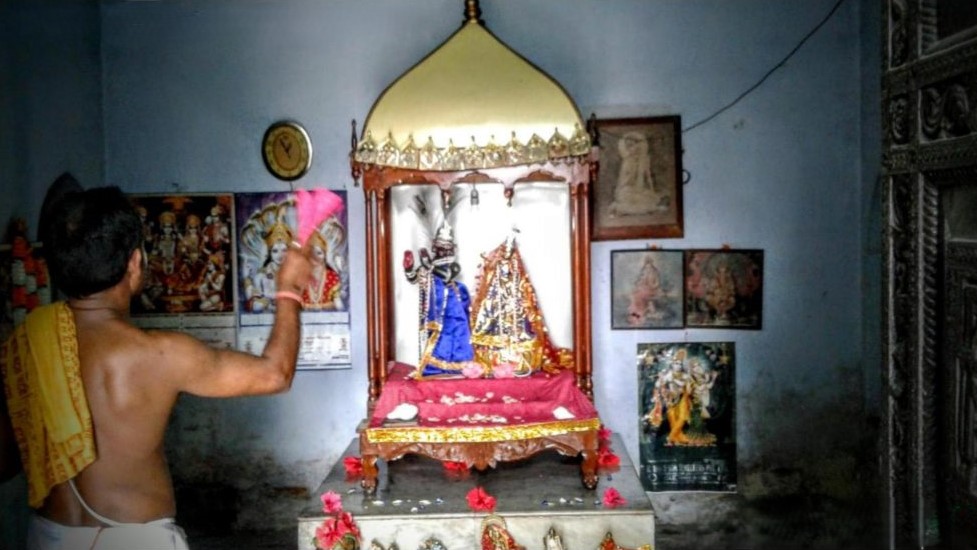 Sri Krishna Raya deities at Halisahar
This temple stands in the village of Kanchadapada, about one and a half miles from Kumarahatta. Srinatha Pandita, Sivananda Sena’s own spiritual master, separately established a second temple at the same site with Deities of Sri Sri Radha-Krishna, worshipped there under the name Sri Krishna Raya. The large temple structure that exists today was constructed considerably later, in 1786, by a zamindar named Nimai Mullik of Calcutta, after he came upon the same site — by then a ruined, broken-down temple on the bank of the Ganges — while travelling to Benares, and was moved to rebuild it. Tradition further holds that the Krishna Raya Deity presently worshipped there was carved, along with two other Deities now installed elsewhere, from a single large stone brought by Virabhadra Prabhu, the son of Lord Nityananda.
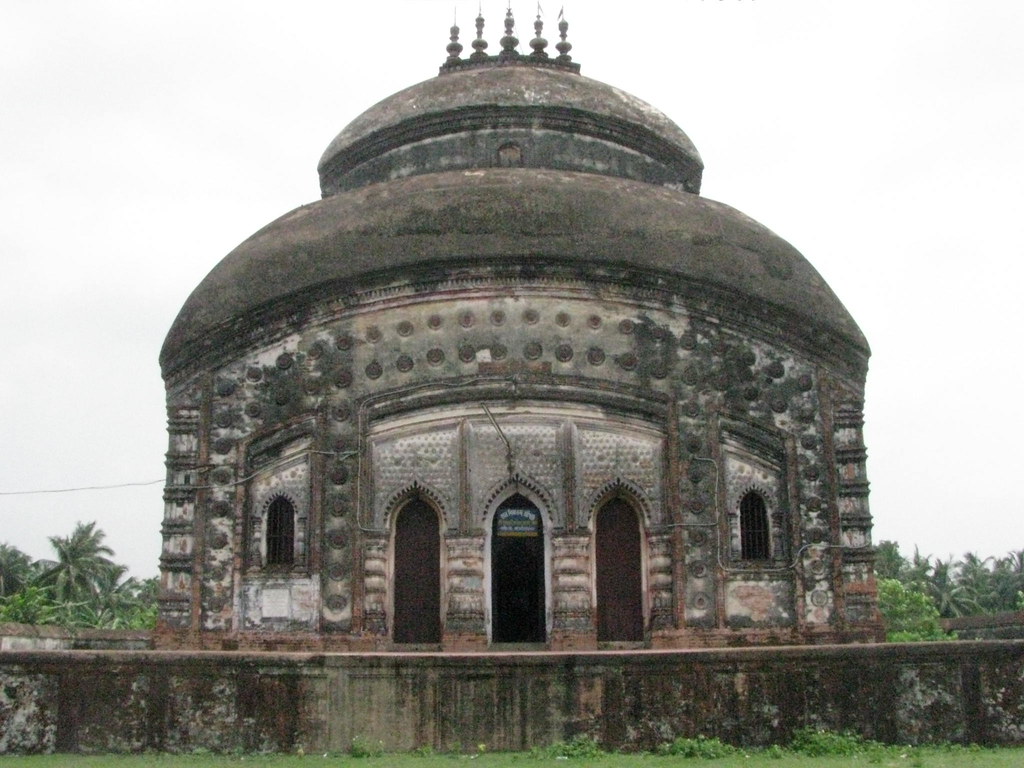 Sri Krishna Raya Temple, Halisahar
An Eternal Resident of Vraja Who Never Physically Visited Vrindavana
In a purport concerning the difference between genuine spiritual life in Vrindavana and its material imitation, Srila Prabhupada makes a striking and instructive point about Sivananda Sena’s own spiritual position. Warning against those who go to Vrindavana merely for worldly or sentimental reasons, he lists a small number of the Lord’s most exalted associates who, according to Srila Bhaktisiddhanta Sarasvati Thakura, have no historical record of ever having physically travelled to Vrindavana-dhama at all:
Svarupa Damodara did not even come to Vrindavana-dhama.
— Srila Prabhupada, Sri Caitanya-caritamrta, Madhya-lila 16.281, Purport
Sivananda Sena is named in this same short list, alongside Svarupa Damodara, Sri Pundarika Vidyanidhi, Sri Haridasa Thakura, Srivasa Pandita, Sri Ramananda Raya, and others. The point Srila Prabhupada draws from this is not that these devotees lacked connection to Vrindavana — quite the opposite. As eternal residents of the spiritual Vrindavana itself, their physical presence in the earthly dhama was never required; the real Vrindavana, he explains, is appreciated only by a devotee whose eyes have been purified by love, and such a devotee sees no difference between the Vrindavana of this world and the original Goloka Vrindavana in the spiritual sky.
Lila Sthali: Places Sanctified by Sivananda Sena
- Kumarahatta (present-day Halisahar), West Bengal — Sivananda Sena’s own residence, and the neighbouring home of Vasudeva Datta, whose household affairs Sivananda Sena managed at the Lord’s own request.
- Kanchadapada (also spelled Kanchanapalli), about one and a half miles from Kumarahatta — the site of the Gaura-Gopala Deities installed by Sivananda Sena himself, and of the separate Sri Krishna Raya temple established by his spiritual master, Srinatha Pandita, where Sri Sri Radha-Krishna are worshipped to this day. Sri Chaitanya Mahaprabhu personally stayed at Sivananda Sena’s house here for two days during His own travels.
- Jagannatha Puri, Odisha — the destination of Sivananda Sena’s yearly pilgrimage with the devotees of Bengal, and the place where the dog he had carried the entire distance was finally liberated by the sight of the Lord’s lotus feet.
What Sivananda Sena Teaches Us
- Unglamorous, repeated service is not a lesser form of devotion — it is very often the highest. Sivananda Sena is remembered for no single miracle performed by his own hand, no philosophical treatise, no poetic composition of his own. He is remembered for organising the same pilgrimage, year after year, clearing the same tax posts, arranging the same lodging, carrying the same responsibility for other people’s comfort and safety on a long and difficult road. Krishna consciousness does not require every devotee to produce something spectacular. It asks, far more often, for someone reliable enough to be trusted with the same essential service every single year — and Sivananda Sena’s eternal identity, as an incarnation of two gopis combined into one soul, shows exactly how dear this kind of steady, self-effacing service is to the Lord.
- A devotee's compassion does not stop at the boundary of the human species. Sivananda Sena did not need the dog that joined his party to be useful, grateful, or even aware of what was happening to it. He simply allowed it to remain in the association of devotees, and that association alone was sufficient for its liberation. Srila Prabhupada returns to this incident again and again precisely because it demonstrates, without any ambiguity, that a genuine devotee’s mercy extends to every living being he encounters — a standard worth remembering whenever we are tempted to limit our own compassion to those we find convenient or deserving.
- Being entrusted with another devotee's welfare is itself a mark of the Lord's confidence, not a distraction from one's own spiritual life. When Sri Chaitanya Mahaprabhu personally asked Sivananda Sena to manage Vasudeva Datta’s household affairs, He was not assigning him a mundane administrative chore separate from devotional life. Taking responsibility for a fellow devotee’s practical wellbeing, at the Lord’s own request, is itself an intimate service — one that requires the same surrender and attentiveness as any other form of worship.
- Even a harsh word from the Lord's own associate should be received as mercy, not injury. When Nityananda Prabhu cursed his sons and later kicked him in an ecstatic mood of hunger, Sivananda Sena did not protest, argue, or withdraw his service. He told his grieving wife that he was prepared to accept whatever Nityananda Prabhu desired, even the death of his own children. This is not passivity; it is the deepest possible trust that everything coming from a pure devotee of the Lord, however it appears on the surface, is ultimately for one’s own spiritual benefit.
Common Questions About Sivananda Sena
Who was Sivananda Sena?
Sivananda Sena was a householder devotee of Sri Chaitanya Mahaprabhu, listed as the twenty-fourth branch of the Chaitanya tree, who personally organised and financed the annual pilgrimage of Bengali devotees to Jagannatha Puri and served as manager of Vasudeva Datta’s household at the Lord’s own request.
What is Sivananda Sena best known for?
He is best known for personally guiding, feeding, and financing the party of devotees who travelled every year from Bengal to Jagannatha Puri, and for the pastime in which a dog he allowed to accompany his party was liberated after seeing Sri Chaitanya Mahaprabhu.
Whose incarnation is Sivananda Sena considered to be?
According to Kavi-karnapura’s Gaura-ganoddesha-dipika (verse 176), Sivananda Sena is the combined incarnation of two gopis of Vrindavana who were formerly named Vira and Duti.
Who were Sivananda Sena's sons?
He had three sons: Chaitanya dasa, the eldest; Ramadasa, the second; and Paramananda Sena, the youngest, far better known by his literary names Puri dasa and Kavi-karnapura, the author of the Gaura-ganoddesha-dipika and several other major Sanskrit works of the Gaudiya Vaishnava tradition.
When is Sivananda Sena's disappearance day observed?
As with all Vaishnava commemorative days, the date follows the lunar (tithi) calendar and shifts each year. Devotional tradition holds his disappearance to have occurred on the same day as that of Srila Svarupa Damodara Gosvami, coinciding with the annual Jagannatha Ratha-yatra festival in Puri. Please refer to the current Gaudiya Vaishnava calendar for the exact date.
Visit Daksina Dvaraka Dham, Chennai
ISKCON Thiruvanmiyur, Chennai
Join us for daily Srimad-Bhagavatam classes, sankirtana and deity darsana
- Morning Arati 4:30 AM
- Bhagavatam Class 8.05 AM
- Evening Arati 7:00 PM
- Harinaam sankirtan 7.35 AM
Connect with Us
Follow Hare Krsna Movement Chennai across all platforms for daily darsana and event updates.