Gaudiya Vaishnava Saints Series
Srila Sanatana Gosvami
The Teacher of Devotional Service: Glorifying the eldest of the Six Gosvamis of Vrindavana, who gave up a minister's fortune to receive, and then teach the world, the science of pure devotional service.
Among the Six Gosvamis of Vrindavana, Srila Sanatana Gosvami holds the position of the eldest — not merely in age, but in the sense that Sri Chaitanya Mahaprabhu personally chose him to receive, in the most systematic and detailed form, the entire science of devotional service, so that he could then transmit it to everyone else. A former chief minister of the Muslim government of Bengal, learned in Sanskrit, Persian, and Arabic, Sanatana Gosvami gave up wealth, position, and family entirely, and after a harrowing escape from imprisonment, sat before Sri Chaitanya Mahaprabhu at Varanasi as a humble student, prepared to unlearn everything he thought he knew.
Srila Prabhupada describes him simply, in his purport introducing the Six Gosvamis' literary contribution, as the teacher of the science of devotional service who wrote several foundational books explaining exactly what a devotee, and devotional service itself, actually consist of.
Quick Facts
Quick Facts
Glorification of Srila Sanatana Gosvami
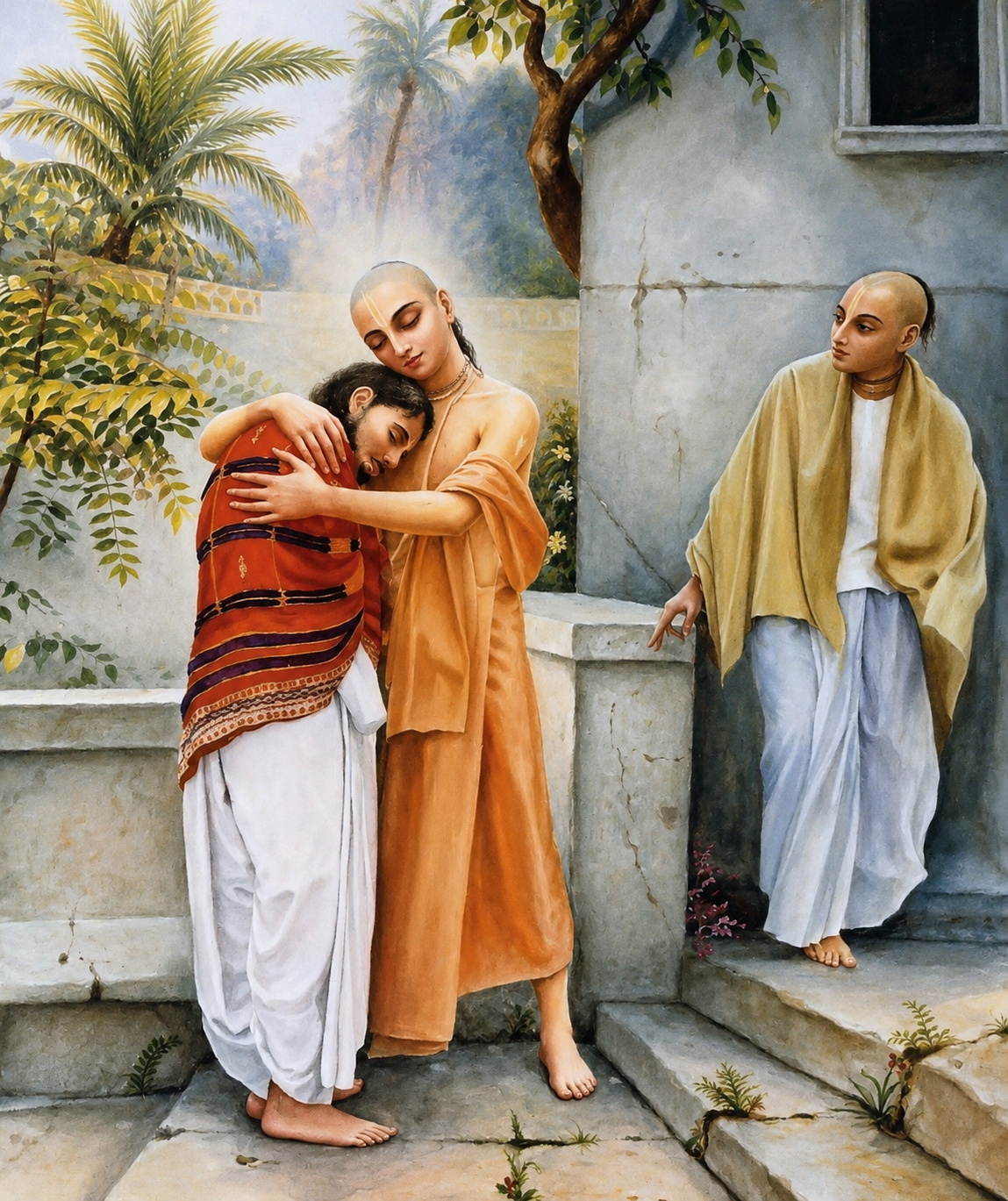 Srila Sanatana Gosvami, eldest of the Six Gosvamis of Vrindavana.
Srila Sanatana Gosvami is glorified together with his younger brother Srila Rupa Gosvami and the other Gosvamis in Srinivasa Acharya's Sad-gosvamy-ashtaka, a prayer of homage to all six of them. Srila Prabhupada quotes its fourth verse specifically in connection with Rupa and Sanatana's renunciation of their ministerial post:
tyaktvā tūrṇam aśeṣa-maṇḍala-pati-śreṇīṁ sadā tuccha-vat
bhūtvā dīna-gaṇeśakau karuṇayā kaupīna-kanthāśritau
gopī-bhāva-rasāmṛtābdhi-laharī-kallola-magnau muhur
vande rūpa-sanātanau raghu-yugau śrī-jīva-gopālakau
Translation: I offer my obeisances to Sri Rupa and Sanatana, who at once gave up the association of every worldly ruler as insignificant, mercifully became the protectors of the fallen, and remain forever plunged in the waves of the nectar ocean of the gopis' love — together with the two Raghunathas, Sri Jiva, and Gopala Bhatta.
Reference: Sri Sri Sad-gosvamy-ashtaka, verse 4 (Srinivasa Acharya), quoted by Srila Prabhupada in his Nectar of Devotion lecture series, Vrindavana, October 1972
A Minister's Life, and the Decision to Leave It
Srila Prabhupada traces Sanatana Gosvami's family lineage in some detail in his purport to the Adi-lila, going back to a gentleman named Sarvajna who appeared in a wealthy brahmana family of Karnata in the twelfth century Sakabda era. Several generations later, this family's line moved to Naihati in Bengal on the bank of the Ganges, and eventually settled at Phateyabad, bordering Bakla-Chandradvipa in what is now Bangladesh. It was from this same family that Sanatana Gosvami, his brother Rupa Gosvami, and their brother Vallabha (Anupama) were all born, before relocating to Ramakeli in the Malda district of Bengal, where they served as ministers.
Before he was Sanatana Gosvami, he was known as Sakara Mallik, holding one of the two most powerful ministerial posts in the government of Nawab Hussain Shah, the Muslim ruler of Bengal in the early sixteenth century. Srila Prabhupada describes the weight of what such a position actually cost a soul seeking Krishna, in Sanatana Gosvami's own later words of self-assessment before Sri Chaitanya Mahaprabhu:
"I was born in a low family, and my associates are all low-class men."
— Sri Sanatana Gosvami, quoted by Srila Prabhupada, Sri Caitanya-caritamrta, Madhya-lila 20.99, Translation
Srila Prabhupada's purport clarifies immediately that this was not a statement of actual social fact — Sanatana Gosvami belonged to a respected Sarasvata brahmana family — but a statement of spiritual self-assessment. Holding a minister's post in a Muslim court had forced him into constant association with meat-eaters and drunkards, and by that association, he considered himself to have fallen, however elevated his birth.
The turning point came when Sri Chaitanya Mahaprabhu, travelling to Bengal to see His mother, passed through Ramakeli. All three brothers came before the Lord and offered their obeisances, and even the infant Jiva was brought before Sri Chaitanya Mahaprabhu on this occasion. After the Lord departed for Puri, the brothers began keeping vows of their own to secure shelter at His feet. Rupa and Anupama soon resigned their posts and departed with their accumulated wealth, leaving Sanatana alone to face the Nawab's displeasure.
Reference: Sri Chaitanya-charitamrita, Adi-lila 10.84, Purport; Madhya-lila 1 and 20.99, Purports
Escape from Prison, and the Test of Renunciation
While in confinement, Sanatana Gosvami received word from his brother Rupa that eight hundred gold coins had been deposited with a grocer for his use. Srila Prabhupada records the outcome plainly:
"Sanatana Gosvami took advantage of this money to bribe the jail keeper."
— Srila Prabhupada, Sri Caitanya-caritamrta, Adi-lila 10.84, Purport
He set out for Varanasi with a single servant, Ishana, who secretly carried the remaining gold coins. At a wayside inn, the innkeeper's suspiciously excessive hospitality alerted Sanatana Gosvami that the man had learned of the money and intended to murder them for it. Rather than concealing the coins more carefully, Sanatana Gosvami simply took the money from Ishana and handed all of it over to the innkeeper, asking only for safe passage the rest of the way.
Sanatana Gosvami arrived at Varanasi dressed in torn, dirty clothes, his hair and beard completely unkempt, carrying nothing but a beggar's pot. When Sri Chaitanya Mahaprabhu had him properly dressed and shaved so that he would appear as a gentleman, Sanatana Gosvami accepted new cloth from Chandrashekhara but almost immediately exchanged it for a single old, torn dhoti, which he tore further into two pieces to serve as his only lower and upper garments — abandoning, quite literally, the very last of his former wealth.
Reference: Sri Chaitanya-charitamrita, Adi-lila 10.84 and Madhya-lila 20, Purports
Two Months of Confidential Teaching at Varanasi
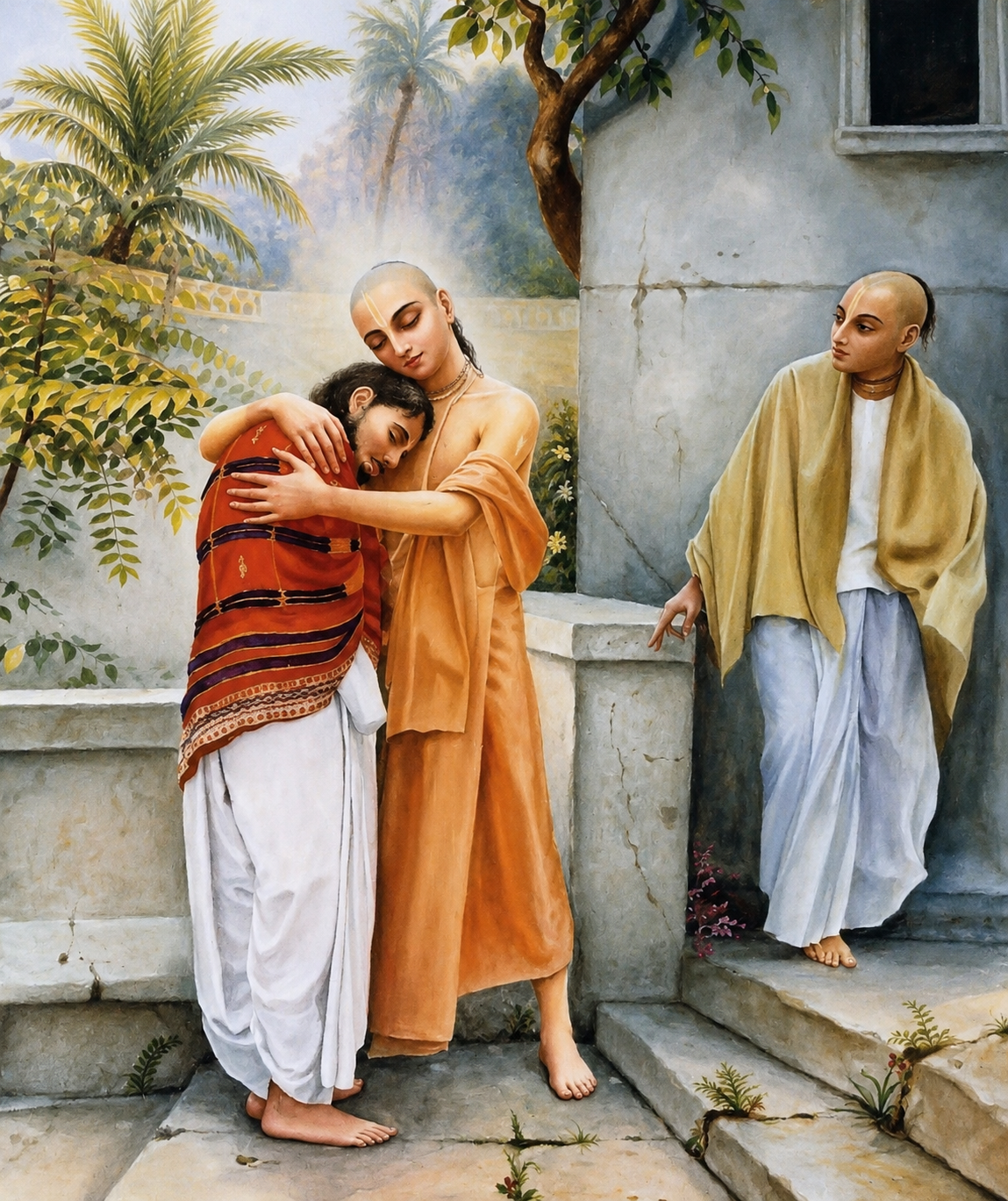 Lord Chaitanya embraces Srila Sanatana Goswami at Tapan Mishra's house in Varanasi.
For two consecutive months, Sri Chaitanya Mahaprabhu personally instructed Sanatana Gosvami in the complete science of devotional service, an event Srila Prabhupada summarises with striking simplicity:
"Lord Caitanya Mahaprabhu instructed Sri Sanatana Gosvami in all the conclusions of devotional service."
— Srila Prabhupada, Sri Caitanya-caritamrta, Madhya-lila 25.1, Translation
These teachings, recorded across Chapters Twenty through Twenty-Five of the Madhya-lila, cover the constitutional position of the living entity, the opulence and sweetness of Krishna, the process and goal of devotional service, and the celebrated sixty-one explanations of the atmarama verse from Srimad-Bhagavatam. Sri Chaitanya Mahaprabhu began at the very foundation:
"jīvera 'svarūpa' haya — kṛṣṇera 'nitya-dāsa'"
"It is the living entity's constitutional position to be an eternal servant of Krishna."
— Srila Prabhupada, Sri Caitanya-caritamrta, Madhya-lila 20.108–109, Translation
Srila Prabhupada explains in his purport that this single instruction is the foundation on which everything else Sanatana Gosvami would later teach and write depends: the living entity is simultaneously one with and different from Krishna, exactly as a ray of sunshine is both part of the sun and distinct from it.
Reference: Sri Chaitanya-charitamrita, Madhya-lila, Chapters 20–25
Sent to Vrindavana: Founder of Deity Worship
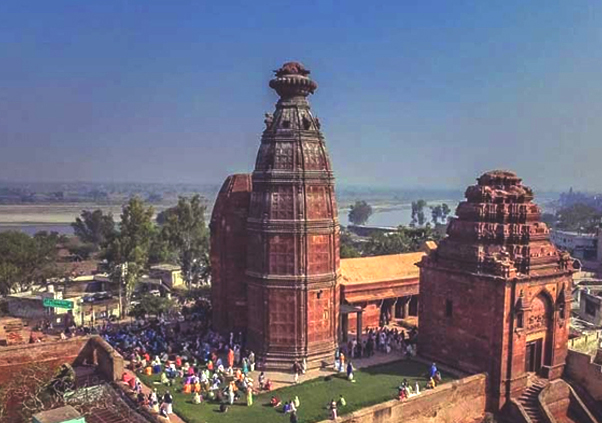 Sri Sri Radha-Madana-mohana temple, Vrindavana, established by Srila Sanatana Goswami.
After completing His instruction, Sri Chaitanya Mahaprabhu sent Sanatana Gosvami to Vrindavana with a fourfold mission: to excavate the lost places of Krishna's pastimes, to install Deities and establish proper Deity worship, to write books systematically presenting the science of devotional service, and to establish Vaishnava etiquette. When Rupa and Sanatana Gosvami first arrived, Vrindavana was largely an empty forest; they had no fixed residence, slept beneath different trees each night, and lived on whatever alms they could beg.
It was Sanatana Gosvami who first established Deity worship in Vrindavana, installing the Deity of Sri Sri Madana-mohana — an event Srila Prabhupada and the disciplic tradition regard as the actual founding of what would become the modern temple city of Vrindavana.
Reference: Sri Chaitanya-charitamrita, Adi-lila 7 and Madhya-lila 1, 19; Antya-lila 4
How Madana-mohana Came to Live With a Beggar
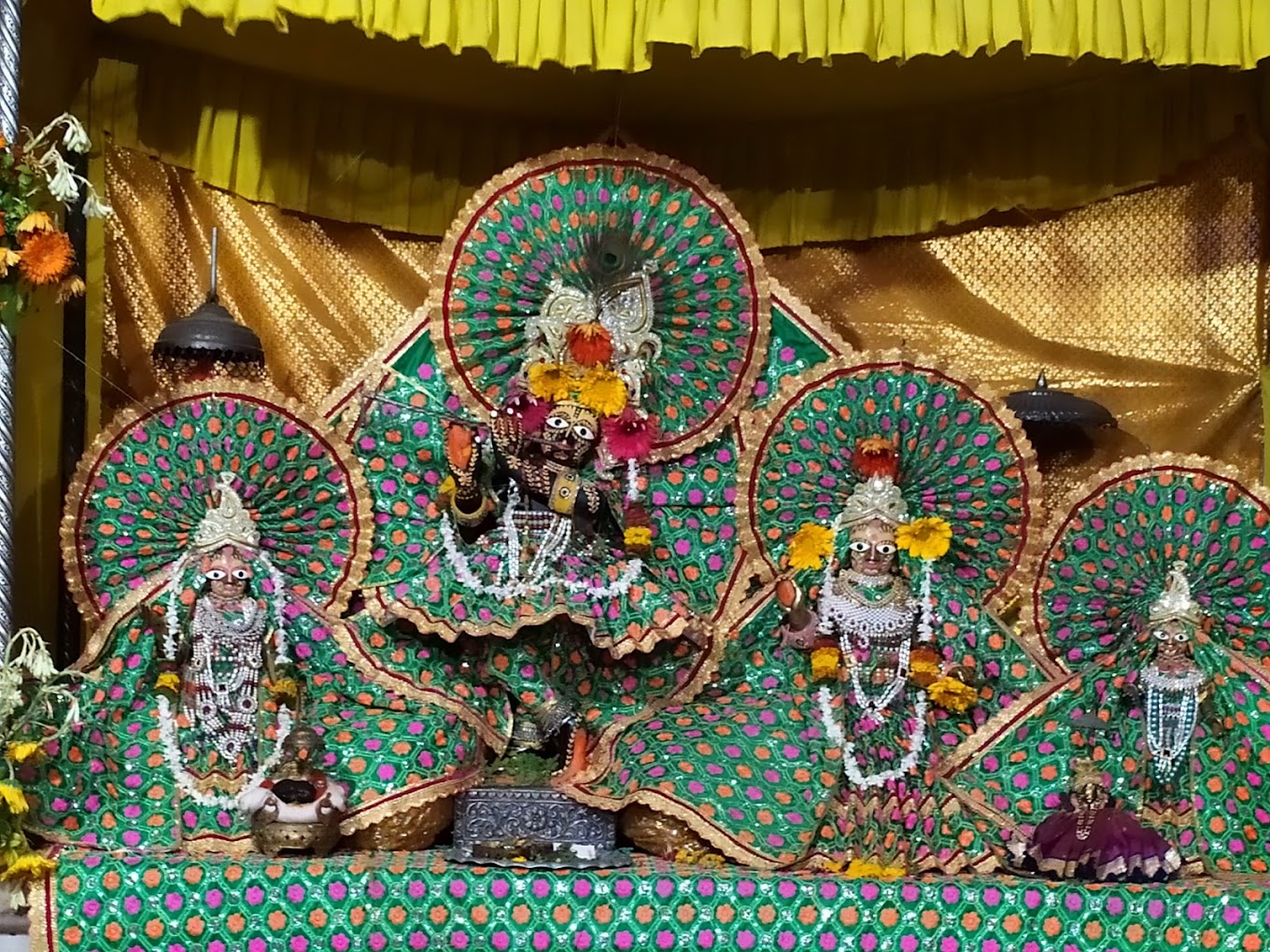 From left to right stand Lalita Sakhi, Lord Madan Mohan holding a flute, Srimati Radharani, and Ananga Manjari at Madan Mohan Temple.
The story of how the Madana-mohana Deity came into Sanatana Gosvami's care is preserved in Bhakti-ratnakara. The Deity was residing in the home of a Mathura brahmana named Damodara Chaube. Both Sanatana Gosvami and the brahmana's wife separately had a dream in which Madana Gopala expressed His wish to live with Sanatana Gosvami. Sanatana Gosvami accepted the Deity, built a small hut on a hillock, and began to serve Him there.
Living purely on alms, Sanatana Gosvami had nothing to offer the Deity but plain, dry chapatis without salt. Srila Prabhupada narrated what happened next:
"Sanatana, you are bringing all these dry chapatis, without even little salt."
— Srila Prabhupada, Lecture, Deity Installation, Los Angeles, July 16, 1969
Sanatana Gosvami explained to the Deity that he was an old man with books to write, that he could not go running after salt and sweets, and that Madana-mohana would have to accept the plain chapati or arrange something better Himself. Soon after, a wealthy merchant named Krishnadasa Kapoor whose boat was stuck on a sandbar prayed to Madana-mohana, sold his goods, and used the profits to build a magnificent temple for Madana-mohana.
Reference: Srila Prabhupada, Lecture, Los Angeles, July 16, 1969; Sri Narahari Chakravarti Thakura, Bhakti-ratnakara
The Vow, and the Govardhana-shila
Sanatana Gosvami had taken a strict personal vow to circumambulate Govardhana Hill every single day without fail. As he grew older and infirm, walking around Govardhana Hill each day became a severe physical hardship.
Rather than allow His elderly devotee to suffer, Krishna appeared before Sanatana Gosvami as a young cowherd boy, stood upon a flat stone from Govardhana Hill, and played His flute until the stone melted and took the impression of His lotus feet. Presenting the stone to Sanatana Gosvami, Krishna told him that circumambulating this single shila would be equal to circumambulating all of Govardhana Hill — allowing Sanatana Gosvami to keep his vow intact. This Govardhana-shila is worshipped by devotees to this day.
Reference: Gaudiya Vaishnava literature (Bhakti-ratnakara)
Radharani's Hidden Gift of Rice
One day, Srila Rupa Gosvami wished to prepare sweet rice for his elder brother Sanatana Gosvami, but lacked milk and sugar. A young girl appeared at his hut and offered rice, milk, and sugar as a gift. When Sanatana Gosvami tasted the extraordinarily sweet prasadam, he asked where the ingredients came from — and declared with tears that no one but Srimati Radharani Herself could have supplied such divine ingredients.
Reference: Gaudiya Vaishnava literature (Bhakti-ratnakara)
The Touchstone and the Poor Brahmana
A poor brahmana, having worshipped Lord Shiva for the best benediction, was directed to seek it from Sanatana Gosvami. Srila Prabhupada tells what happened:
"He had a touchstone with him, left in a pile of refuse."
— Srila Prabhupada, Srimad-Bhagavatam 4.7.7, Purport
The brahmana received the touchstone (which turns iron to gold), but realized that if Sanatana Gosvami kept such a stone in garbage, he must possess something far greater. Returning, he threw the touchstone into the river and received initiation into the Hare Krishna maha-mantra from Sanatana Gosvami.
Reference: Srimad-Bhagavatam 4.7.7, Purport
The Skin Disease and the Lord's Forced Embrace
Travelling to Jagannatha Puri to see Sri Chaitanya Mahaprabhu, Sanatana Gosvami contracted painful weeping sores over his entire body. He resolved to end his life beneath the wheels of the Ratha-yatra cart rather than contaminate the Lord. But when he arrived, Sri Chaitanya Mahaprabhu ran and embraced him repeatedly, unconcerned for His own bodily comfort, until every trace of the disease vanished from Sanatana Gosvami's body completely.
Reference: Sri Chaitanya-charitamrita, Antya-lila 4.130–197
Author of the Foundational Gosvami Literature
At Sri Chaitanya Mahaprabhu's instruction, Sanatana Gosvami authored three foundational works:
"Anyone who wants to know about devotees and devotional service must read this book."
— Srila Prabhupada, Sri Caitanya-caritamrta, Adi-lila 5.203, Purport, on Brihad-Bhagavatamrita
The Brihad-Bhagavatamrita systematically presents the gradations of devotees; Hari-bhakti-vilasa establishes Vaishnava rules and etiquette; and Sri Vaishnava-toshani (Dashama-tippani) is a rich commentary on the Tenth Canto of Srimad-Bhagavatam.
Reference: Sri Chaitanya-charitamrita, Adi-lila 5.203, Purport
Lila Sthali: Places Sanctified by Sanatana Gosvami
Ramakeli, Malda district, West Bengal
Capital of Nawab Hussain Shah's Bengal government, where Sanatana Gosvami served as chief minister alongside his brother Rupa, and where Sri Chaitanya Mahaprabhu first accepted their obeisances. It was here that Sanatana Gosvami's resolve to leave ministerial life first took shape.
Varanasi (Kashi), Uttar Pradesh
Where Sanatana Gosvami arrived after his escape from prison, and where Sri Chaitanya Mahaprabhu personally instructed him for two months in the complete science of devotional service, converting the Mayavadi sannyasis headed by Prakashananda Sarasvati into Vaishnavas.
Sri Sri Radha-Madana-mohana Temple, Vrindavana
The first Deity worship established in Vrindavana by Sanatana Gosvami himself at the Lord's instruction. His samadhi is located beside this temple, where Krishna appeared before him as a cowherd boy and gave him the Govardhana-shila bearing His own footprints.
Radha-kunda and Syama-kunda, Vraja
The sacred pair of ponds rediscovered by Sri Chaitanya Mahaprabhu. At the Lord's direction, Sanatana Gosvami and Rupa Gosvami renovated and re-excavated both kundas.
Govardhana Hill, Vraja
The site of Sanatana Gosvami's lifelong vow of daily circumambulation, and of Krishna's mercy in providing the shila that allowed him to keep that vow in his old age.
Pavan Sarovar, Nandagrama, Vraja
The site of Sanatana Gosvami's bhajan-kutir, where he was so absorbed in chanting that Krishna Himself brought a pot of fresh milk to him.
Jagannatha Puri, Odisha
Where Sanatana Gosvami, suffering from skin disease, resolved to end his life beneath the Ratha-yatra wheels, and where Sri Chaitanya Mahaprabhu's forced embrace cured him completely.
Lessons for the Devotee
Krishna accepts the sincerity of an offering, never its material value.
Sanatana Gosvami had nothing to give his Deity but plain dry chapatis without salt — yet Madana-mohana accepted this simple offering year after year because it came from a heart with nothing held back.
No worldly position, however powerful or comfortable, is worth clinging to once Krishna's service calls.
Sanatana Gosvami held one of the two most powerful ministerial posts in Bengal. He gave up every bit of it, enduring imprisonment and arriving as a beggar, because no worldly position compared to sitting at the feet of Sri Chaitanya Mahaprabhu.
Real humility means seeing one's own past honestly, not performing false modesty.
When Sanatana Gosvami told Sri Chaitanya Mahaprabhu that he considered himself fallen, he was honestly reporting the state of his heart after serving in a court surrounded by materialists, seeking spiritual purification.
A devotee's compassion is never limited by calculating what he personally stands to gain.
Sanatana Gosvami gave the poor brahmana his touchstone without a second thought, and when the brahmana asked for something higher, he gave initiation into the holy name.
Shame over one's bodily condition should never block the association of a pure devotee.
Sanatana Gosvami's instinct to protect Sri Chaitanya Mahaprabhu from his diseased body was out of devotion, but the Lord showed that His embrace purifies everything, healing Sanatana Gosvami instantly.
Frequently Asked Questions
Connect with Us
Follow Hare Krsna Movement Chennai across all platforms for daily darsana and event updates.
Srila Prabhupada's ISKCON Thiruvanmiyur | Dakshina Dwaraka Dham, Chennai