Vaishnava Acharyas & Associates
Sri Svarupa Damodara Gosvami
The secretary, singer, and most intimate confidant of Sri Chaitanya Mahaprabhu's final twelve years
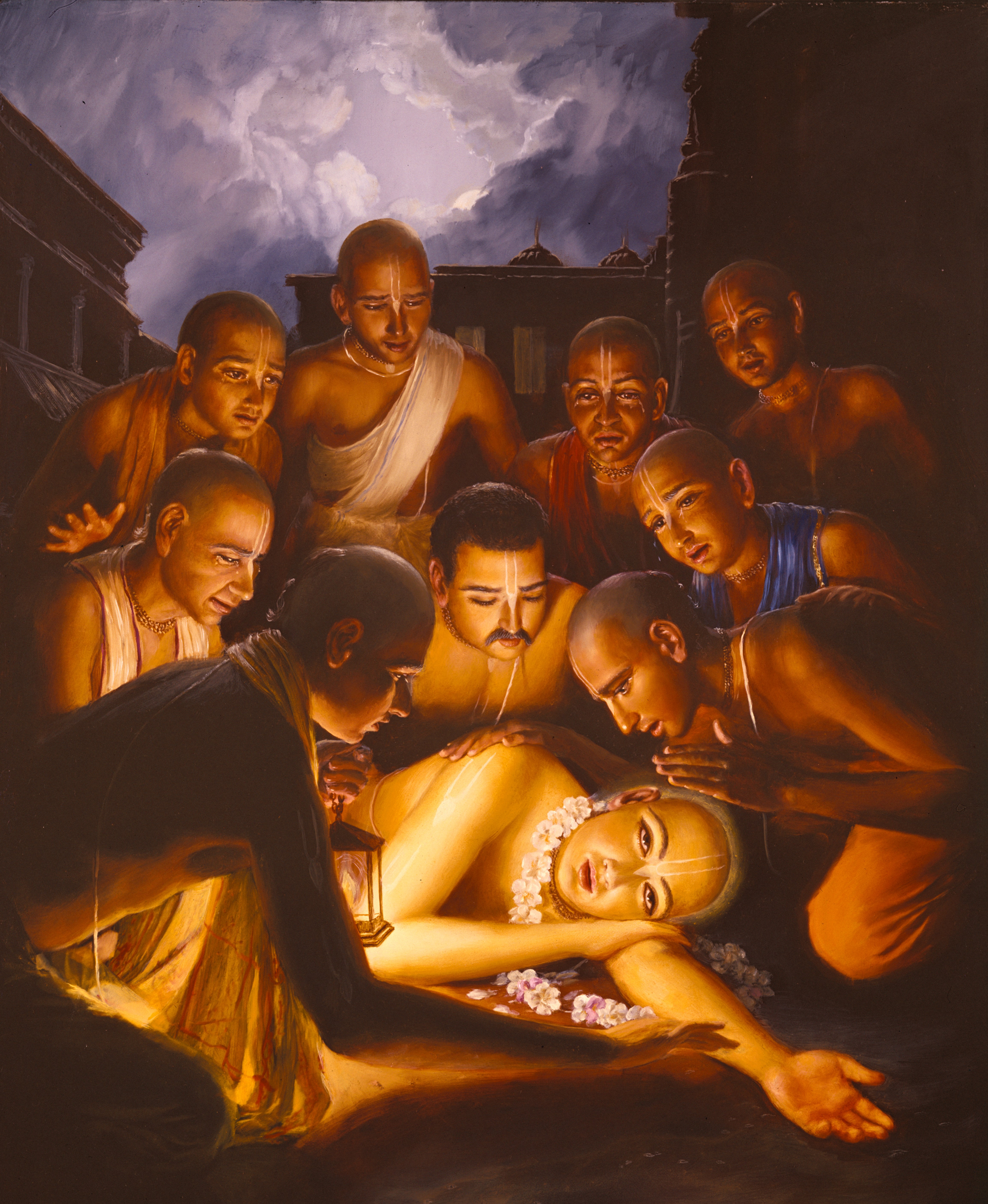 Sri Svarupa Damodara Gosvami
Svarupa Damodara falls at the Lord’s feet, breathless from his journey from Varanasi. “Please forgive me,” he says. “I gave up Your company to go elsewhere, and that was my great mistake.” Sri Chaitanya Mahaprabhu lifts him up and embraces him, weeping: “I saw in a dream that you were coming, and so this is very auspicious. I have been like a blind man, but your coming here restores My vision.”
(CC Madhya 10.122–123)
From that reunion in Jagannatha Puri until the Lord’s final days, Svarupa Damodara would not leave His side again. This is his story.
Quick Facts, at a Glance
- Purvashram name
- Purushottama Acharya, a resident of Navadvipa, already devoted to Lord Chaitanya before His sannyasa
- Sannyasa
- Took brahmacharya/sannyasa in Varanasi under Chaitanyananda Bharati; renamed Damodara Svarupa, later Svarupa Damodara
- Role in Puri
- The Lord’s personal secretary and literary examiner; every book, poem, or song meant for the Lord was first heard by him
- Vraja identity
- The gopi Vishakha-sakhi, per the Gaura-ganoddesa-dipika (147–160), who formerly taught Radharani the fine arts in Vraja
- Rank among associates
- One of Mahaprabhu’s “three and a half” most confidential devotees in the entire world — with Ramananda Raya, Shikhi Mahiti, and (as the “half”) Shikhi Mahiti’s sister Madhavi-devi
- Known for
- Singing to console Mahaprabhu in His moods of separation from Krishna; called “life and soul of the devotees”
- Legacy
- His diary (kadaca) — passed to Raghunatha dasa Gosvami, then to Krishnadasa Kaviraja Gosvami — forms the very basis of Sri Chaitanya-charitamrita
- Principal lila sthalis
- Navadvipa (purvashram) · Varanasi (sannyasa) · Gambhira / Satasan Math, Jagannatha Puri (residence and seva)
Introduction
Among all the associates of Sri Chaitanya Mahaprabhu, one name recurs more than almost any other in the pages of Sri Chaitanya-charitamrita: Svarupa Damodara Gosvami. He was the Lord’s secretary, His literary censor, His singer in the night, and — in the final analysis — the very source through which the intimate pastimes of Chaitanya Mahaprabhu’s last twelve years came to be known at all. Without Svarupa Damodara’s notes, memorized by Raghunatha dasa Gosvami and passed to Krishnadasa Kaviraja Gosvami, the Antya-lila portion of Chaitanya-charitamrita as we know it would not exist. (CC Madhya 2.84)
What follows traces his life from a government scholar’s household in Navadvipa, through a lonely sannyasa taken in grief in Varanasi, to the innermost circle of His Divine Grace Vishwa Guru A.C. Bhaktivedanta Swami Prabhupada’s beloved Sri Chaitanya Mahaprabhu’s pastimes in Jagannatha Puri, as recorded in Srila Prabhupada’s Sri Chaitanya-charitamrita.
Purvashram: Purushottama Acharya of Navadvipa
Before he was known as Svarupa Damodara, he was Purushottama Acharya, a resident of Navadvipa who had already taken shelter of Sri Chaitanya Mahaprabhu’s lotus feet in his youth, prior to the Lord’s acceptance of the renounced order. (CC Adi 4.105, purport)
Srila Prabhupada notes that he was deeply learned and had a natural attraction to the mellows of pure devotion even before the sankirtana movement began in earnest.
When Sri Chaitanya Mahaprabhu accepted sannyasa, the news struck Purushottama Acharya like grief itself. Srila Prabhupada writes:
When Svarupa Damodara was residing at Navadvipa under the shelter of Sri Caitanya Mahaprabhu, his name was Purusottama Acarya. After seeing that Sri Caitanya Mahaprabhu accepted the renounced order, Purusottama Acarya became like a madman and immediately went to Varanasi to take sannyasa.
— CC Madhya 10.103–104
He could not bear to remain a householder while his beloved Lord had renounced the world; and so, almost in madness, he too left everything behind.
Taking Sannyasa in Varanasi
In Varanasi (Kashi), Purushottama Acharya accepted the renounced order under a sannyasa-guru named Chaitanyananda Bharati. At the conclusion of the ceremony, his guru gave him a striking instruction:
Read the Vedanta-sutra and teach it to all others.
— CC Madhya 10.105
Yet, as Srila Prabhupada explains, his heart was elsewhere:
Svarupa Damodara was a great renunciant as well as a great learned scholar. With heart and soul he took shelter of the Supreme Personality of Godhead, Sri Krsna. He was very enthusiastic to worship Sri Krsna without disturbance, and therefore, almost in madness, he accepted the sannyasa order.
— CC Madhya 10.106–107
He did not even complete the formal rituals of sannyasa in the conventional sense — accepting only the vairagi’s simplicity, giving up his sacred thread and shikha — before setting out again to find his Lord. His sannyasa name, given in Varanasi, was Damodara Svarupa; Sri Chaitanya Mahaprabhu would later reorder the name to Svarupa Damodara, adding “Damodara” Himself in recognition of his exceptional devotion.
Reunion with the Lord in Puri
After receiving permission from his sannyasa-guru, Svarupa Damodara travelled to Nilachala (Jagannatha Puri) to take shelter of Sri Chaitanya Mahaprabhu once again. Srila Prabhupada describes the moment of arrival:
Svarupa Damodara also arrived the next day. He was a very intimate friend of Sri Caitanya Mahaprabhu’s, and he was an ocean of transcendental mellows.
— CC Madhya 10.102
Falling at the Lord’s feet, Svarupa Damodara begged forgiveness for having left His company:
My dear Lord, please excuse my offense. I gave up Your company to go elsewhere, and that was my great mistake. I do not possess even a trace of love for Your lotus feet. If I did, how could I have gone to another country? I am therefore a most sinful man. I gave up Your company, but You did not give me up. By Your rope of mercy You have bound me by the neck and brought me back again to Your lotus feet.
— CC Madhya 10.123–125
Sri Chaitanya Mahaprabhu raised him up and embraced him, both of Them overwhelmed with ecstatic love, and said the Lord had seen his arrival in a dream the night before — comparing his return to a blind man regaining sight. (CC Madhya 10.120–122) Svarupa Damodara then paid his respects in turn to Nityananda Prabhu, Jagadananda, Mukunda, Sankara, Sarvabhauma Bhattacharya, and Paramananda Puri, each of whom embraced him with joy. (CC Madhya 10.126–128) From that day, he did not leave the Lord’s side again.
Identity: Vishakha-sakhi, the Second Self of Mahaprabhu
In the Gaura-ganoddesa-dipika, the classical text of Kavi Karnapura identifying the eternal Vraja identities of Lord Chaitanya’s associates, Svarupa Damodara is named as an incarnation of Vishakha-sakhi — the intimate gopi companion of Srimati Radharani who, in Krishna’s Vrindavan pastimes, had taught Radharani the various fine arts.
Srila Prabhupada’s own purport draws the relevant distinction while describing Gadadhara Pandita, whom the same text identifies as an incarnation of both Radharani and Lalita-sakhi:
In the Gaura-ganoddesa-dipika (147–53) it is stated, ‘Sri Krsna’s pleasure potency, formerly known as Vrndavanesvari, is now personified in the form of Sri Gadadhara Pandita… Formerly, as Lalita-sakhi, she was always devoted to Srimati Radharani. Thus Gadadhara Pandita is simultaneously an incarnation of Srimati Radharani and Lalita-sakhi.’
— CC Adi 10.15, purport
Since Gadadhara Pandita is identified as Lalita-sakhi, the parallel identification of Svarupa Damodara in the Gaura-ganoddesa-dipika is with Vishakha-sakhi, Lalita’s fellow intimate gopi.
Whether named Vishakha or Lalita, the essential point stands: as these two gopis are Srimati Radharani’s most intimate confidantes in Krishna-lila, so Svarupa Damodara (together with Ramananda Raya) served as Sri Chaitanya Mahaprabhu’s most intimate confidant in Gaura-lila.
The Guardian of Every Word Spoken Before the Lord
Svarupa Damodara’s scholarship was, in Srila Prabhupada’s words, without limit — yet he rarely spoke, preferring solitude and silence except in service to the Lord:
Svarupa Damodara was the limit of all learned scholarship, but he did not exchange words with anyone. He simply remained in a solitary place, and no one could understand where he was.
— CC Madhya 10.110
Yet within this silence lay an extraordinary responsibility. Whenever a devotee wished to present a book, poem, or song before Sri Chaitanya Mahaprabhu, it first had to pass through Svarupa Damodara’s examination:
Sri Svarupa Damodara was the personification of ecstatic love, fully cognizant of the transcendental mellows in relationship with Krsna. He directly represented Sri Caitanya Mahaprabhu as His second expansion. If someone wrote a book or composed verses and songs and wanted to recite them before Sri Caitanya Mahaprabhu, Svarupa Damodara would first examine them and then correctly present them.
— CC Madhya 10.111–112
The Lord took no pleasure in hearing literature contrary to devotional conclusions (bhakti-siddhanta), or containing rasabhasa — an improper mixing of incompatible devotional mellows. Svarupa Damodara’s examination protected the purity of everything the Lord heard.
The Hidden Verse of Rupa Gosvami
One of the most cherished pastimes involving Svarupa Damodara took place during Rupa Gosvami’s second meeting with Sri Chaitanya Mahaprabhu, after Rupa Gosvami had come to reside in Jagannatha Puri under the shelter of Haridasa Thakura. During Ratha-yatra, the Lord recited a verse again and again while dancing before the chariot — its purpose known to no one but Svarupa Damodara:
Only Svarupa Damodara Gosvami knew the purpose for which the Lord recited that verse. According to the Lord’s attitude, he used to quote other verses to enable the Lord to relish mellows.
— CC Antya 1.76
Rupa Gosvami, however, could understand the Lord’s intention, and composed a verse of his own in response — in the voice of Srimati Radharani, meeting Krishna again at Kurukshetra yet still longing for the forests of Vrindavana. (CC Antya 1.77–79) He wrote it on a palm leaf and tucked it into the thatch of his roof before leaving to bathe in the sea:
That very personality who stole my heart during my youth is now again my master. These are the same moonlit nights of the month of Caitra. The same fragrance of mālatī flowers is there, and the same sweet breezes are blowing from the kadamba forest. In our intimate relationship, I am also the same lover, yet still my mind is not happy here. I am eager to go back to that place on the bank of the Revā under the Vetasī tree. That is my desire.
— CC Antya 1.78My dear friend, now I have met My very old and dear friend Krishna on this field of Kurukshetra. I am the same Radharani, and now We are meeting together. It is very pleasant, but I would still like to go to the bank of the Yamuna beneath the trees of the forest there. I wish to hear the vibration of His sweet flute playing the fifth note within that forest of Vrindavana.
— CC Antya 1.79After writing this verse on a palm leaf, Rupa Gosvami put it somewhere in his thatched roof and went to bathe in the sea. At that time, Sri Caitanya Mahaprabhu went there to meet him, and when He saw the leaf pushed into the roof and saw the verse, He began to read it. After reading the verse, Sri Caitanya Mahaprabhu was overwhelmed by ecstatic love.
— CC Antya 1.80–82
When Rupa Gosvami returned and fell at His feet, the Lord embraced him, exclaiming, “My heart is very confidential. How did you know My mind in this way?” (CC Antya 1.83–84) He then brought the verse to Svarupa Damodara for examination, asking how Rupa Gosvami could possibly have understood His inner mind. Svarupa Damodara’s reply became a defining statement on how such realization is possible at all:
No one could otherwise understand this meaning. I can therefore guess that previously You bestowed upon him Your causeless mercy.
— CC Antya 1.87
The Lord confirmed that He had indeed empowered Rupa Gosvami at their first meeting in Prayaga, and asked Svarupa Damodara to personally continue his instruction in the confidential truths of transcendental mellows — a request that would shape the entire literary mission of the Gosvamis of Vrindavan. (CC Antya 1.88–90)
“Life and Soul of the Devotees”
Krishnadasa Kaviraja Gosvami’s summary of Svarupa Damodara’s character is among the most quoted descriptions of any of the Lord’s associates:
Svarupa Damodara was as expert a musician as the Gandharvas, and in scriptural discussion he was just like Brhaspati, the priest of the heavenly gods. Therefore it is to be concluded that there was no great personality quite like Svarupa Damodara. Sri Svarupa Damodara was very dear to Advaita Acarya and Nityananda Prabhu, and he was the life and soul of all the devotees, headed by Srivasa Thakura.
— CC Madhya 10.116–117
He compiled a treatise on music called Sangita-Damodara, reflecting his mastery of both devotional science and the performing arts — talents he placed entirely in the service of Sri Chaitanya Mahaprabhu’s pleasure.
One of Mahaprabhu’s “Three and a Half” Most Confidential Devotees
Srila Prabhupada makes a striking statement about just how rare Svarupa Damodara’s position was. Describing Madhavi-devi, the sister of another confidential devotee named Shikhi Mahiti, he writes:
The three were Svarupa Gosani, Sri Ramananda Raya and Sikhi Mahiti, and Sikhi Mahiti’s sister, Madhavidevi, being a woman, was considered the half. Thus it is known that Sri Caitanya Mahaprabhu had three and a half confidential devotees.
— CC Adi 10.137, purport; cf. Antya 2.104–106
In the entire world, in other words, only three and a half people were counted worthy of the Lord’s most confidential association — and Svarupa Damodara stood first among them. This context sharpens everything that follows: the singing through the nights, the guardianship of every verse presented to the Lord, and the role as keeper of pastimes too intimate for general disclosure were not simply duties Svarupa Damodara happened to perform. They were entrusted to him because, in the Lord’s own inner circle, there was almost no one else to entrust them to.
Constant Companion in the Mood of Separation
During the final twelve years of His manifest pastimes in Jagannatha Puri, Sri Chaitanya Mahaprabhu remained absorbed, day and night, in the mood of Radharani’s separation from Krishna. Only two devotees were capable of relishing and easing this ecstasy with Him: Svarupa Damodara and Ramananda Raya.
He also passed His time reading the books and singing the songs of Candidasa and Vidyapati, and listening to quotations from the Jagannatha-vallabha-nataka, Krsna-karnamrta and Gita-govinda. Thus in the association of Svarupa Damodara and Raya Ramananda, Sri Caitanya Mahaprabhu passed His days and nights chanting and hearing with great pleasure.
— CC Madhya 2.77
Srila Prabhupada explains that Sri Chaitanya Mahaprabhu experienced four kinds of loving relationships with different devotees, and that with Gadadhara Pandita, Jagadananda, and Svarupa Damodara, His relationship was specifically in the ecstasy of conjugal love (madhurya-rasa):
Among His associates, Lord Caitanya Mahaprabhu enjoyed paternal loving affection from Paramananda Puri, friendly affection with Ramananda Raya, unalloyed service from Govinda and others, and humors of conjugal love with Gadadhara, Jagadananda and Svarupa Damodara.
— CC Madhya 2.78
In the depths of His separation, the Lord once addressed Svarupa Damodara and Ramananda Raya together, calling them His very life:
My dear friends, you are all My life and soul; therefore I tell you that I possess no wealth of love for Krsna. Consequently My life is poverty-stricken.
— CC Madhya 2.40
Whatever mood arose in the Lord’s heart, Svarupa Damodara would meet it with a song or verse of matching sentiment, easing the Lord’s transcendental agony through the night.
Compiler of the Lord’s Pastimes
Perhaps Svarupa Damodara’s most far-reaching service was one few devotees witnessed directly: he kept a personal diary (kadaca) recording the Lord’s daily pastimes, moods, and conversations. Srila Prabhupada affirms this as the very foundation of Sri Chaitanya-charitamrita itself:
His later pastimes [the madhya-lila and antya-lila] were recorded in the form of notes by His secretary, Svarupa Damodara Gosvami, and thus kept within a book.
— CC Adi 13.16
The pastimes of Sri Caitanya Mahaprabhu are the topmost of jewels. They have been kept in the storehouse of Svarupa Damodara Gosvami, who has explained them to Raghunatha dasa Gosvami, who has repeated them to me.
— CC Madhya 2.84
This transmission had a formal beginning. When Raghunatha dasa Gosvami first came to Jagannatha Puri to take shelter of Sri Chaitanya Mahaprabhu, the Lord placed him directly under Svarupa Damodara’s care:
When Raghunatha dasa Gosvami approached Sri Caitanya Mahaprabhu at Jagannatha Puri, the Lord entrusted him to the care of Svarupa Damodara, His secretary. Thus they both engaged in the confidential service of the Lord. He rendered confidential service to the Lord for sixteen years at Jagannatha Puri.
— CC Adi 10.92–93
For sixteen years, Raghunatha dasa Gosvami served as Svarupa Damodara’s close assistant, absorbing the inner details of the Lord’s pastimes firsthand. (CC Adi 10.97) After Svarupa Damodara’s disappearance, Raghunatha dasa Gosvami — who had memorized his notes — carried this treasury to Vrindavana, where he eventually shared it with Krishnadasa Kaviraja Gosvami. This chain of transmission, from the Lord to Svarupa Damodara to Raghunatha dasa Gosvami to Kaviraja Gosvami, is the literal disciplic line through which Chaitanya-charitamrita reached the world. (CC Madhya 8.312) Even the opening verse of the entire work — “radha-krsna- pranaya-vikrtir hladini saktih” — is drawn directly from Svarupa Damodara’s own diary. (CC Adi 4.55)
Guardian of the Devotees’ Wellbeing
Svarupa Damodara’s care extended beyond scripture and song to the simplest daily needs of the Vaishnava community. During prasadam distribution at the Ratha-yatra festivities, seven devotees headed by him personally served the food to the assembled devotees:
The seven persons headed by Svarupa Damodara who were engaged in distributing prasadam to others then took their meals within the room.
— CC Madhya 12.200
On another occasion, when Sri Chaitanya Mahaprabhu hesitated to sit and eat until the other devotees had been served, it was Svarupa Damodara who gently but firmly insisted:
Unless You sit and take prasadam, no one will accept it.
— CC Madhya 11.202
Small as these moments are, they reveal a devotee equally at home in the heights of rasa-tattva and in the humble, practical service of ensuring every Vaishnava was fed.
Leader of the Sankirtana at Ratha-yatra
During the annual Ratha-yatra festival, Svarupa Damodara held a position of central importance among the kirtana performers:
The two chief performers were Svarupa Damodara and Srivasa Thakura… Svarupa Damodara was chosen as the leader of the first party and was given five assistants to respond to his chanting.
— CC Madhya 13.32–36
His five responsive singers were Damodara Pandita, Narayana, Govinda Datta, Raghava Pandita, and Sri Govindananda. (CC Madhya 13.37) When the Lord wished to jump high in ecstatic dance, it was a group of nine devotees under Svarupa Damodara’s direct charge who ran and sang beside Him to sustain the kirtana. (CC Madhya 13.74–75)
Disappearance
Sri Svarupa Damodara Gosvami remained at Sri Chaitanya Mahaprabhu’s side through the entirety of the Lord’s last twelve years in Jagannatha Puri, right hand in service alongside his own disciple, Raghunatha dasa Gosvami. Traditional Gaudiya Vaishnava sources place his disappearance on the second day of the full moon (dvitiya) in the month of Ashadha — in some accounts coinciding with the season of Ratha-yatra itself. After his disappearance, Raghunatha dasa Gosvami — who had memorized his notes — departed for Vrindavana, carrying with him the treasury of pastimes that would become Sri Chaitanya-charitamrita.
Lila Sthali: Places to Remember Svarupa Damodara Gosvami
The core pastimes above are drawn from Srila Prabhupada’s Sri Chaitanya-charitamrita, with exact verse citations given inline. The site descriptions below draw additionally on temple and pilgrimage tradition, offered as supplementary context for pilgrims — sources are noted inline within each entry and are clearly distinguished from the primary scriptural record.
Navadvipa
West Bengal
Purvashram as Purushottama Acharya. Before his sannyasa, Svarupa Damodara lived here, already devoted to Sri Chaitanya Mahaprabhu in his youth. (CC Madhya 10.103) Navadvipa, on the banks of the Ganges in Nadia district, is the birthplace and early pastime-site of Lord Chaitanya Himself and a major pilgrimage circuit for Gaudiya Vaishnavas.
Varanasi (Kashi)
Uttar Pradesh
Site of his sannyasa. Upon hearing of Mahaprabhu’s sannyasa, Purushottama Acharya travelled here and accepted the renounced order under Chaitanyananda Bharati. (CC Madhya 10.104–105) Varanasi is one of the most ancient pilgrimage cities in India, and was also where Sri Chaitanya Mahaprabhu Himself taught the Vedanta-sutra to the Mayavadi sannyasis there.
Gambhira & Satasan Math
Jagannatha Puri, Odisha
His life’s central seva. It was here that Svarupa Damodara spent the rest of his manifest life, constantly at Sri Chaitanya Mahaprabhu’s side. (CC Madhya 10.109 onward) Secondary tradition places his personal residence at a site remembered as “Satasan Math,” near the ocean at Svargadvara, not far from Bhaktivinoda Thakura’s Bhakti Kutir. The Gambhira — Kashi Mishra’s house, where Mahaprabhu spent His final twelve years — is open to pilgrims today.
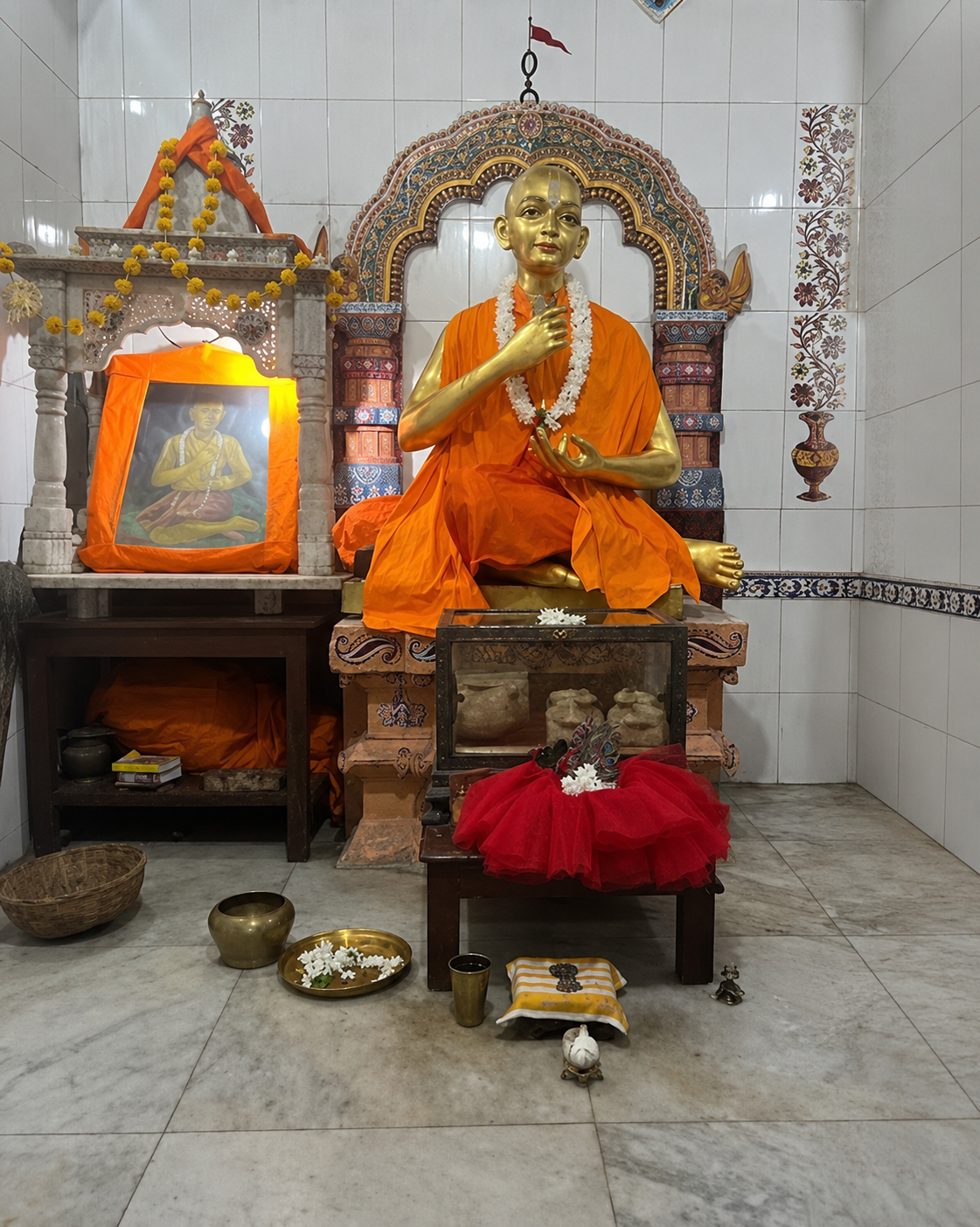 Sri Gambhira, Jagannatha Puri — the sacred residence where Sri Chaitanya Mahaprabhu performed His profound internal pastimes, lovingly attended by Svarupa Damodara Goswami
What Svarupa Damodara Gosvami Teaches Us
Several enduring lessons emerge from Srila Prabhupada’s presentation of Svarupa Damodara’s life:
- Renunciation born of love, not calculation. He left everything — status, scholarship, comfort — not through detached philosophy but through an unbearable longing to remain near his Lord.
- Guarding purity without pride. Though the examiner of everything presented to Sri Chaitanya Mahaprabhu, he remained famously silent and unassuming, never asserting his position over others.
- Scholarship placed entirely in service. His unmatched command of music and scripture were never ends in themselves — they existed solely to bring the Lord transcendental happiness.
- Presence in another’s pain. Night after night, through the Lord’s deepest anguish of separation, Svarupa Damodara simply stayed — singing, listening, and absorbing what he could not fully explain to others.
- Humble service alongside high realization. The same devotee who alone understood Sri Chaitanya Mahaprabhu’s most confidential moods also quietly insisted the Lord sit down and eat with everyone else.
Frequently Asked Questions
Who was Sri Svarupa Damodara Gosvami?
He was the personal secretary and most intimate confidant of Sri Chaitanya Mahaprabhu during His years in Jagannatha Puri, formerly known as Purushottama Acharya of Navadvipa. He examined all literature presented to the Lord, sang to console Him in separation from Krishna, and kept the diary that became the basis of Sri Chaitanya-charitamrita.
What was Svarupa Damodara’s identity in Krishna’s Vrindavan pastimes?
The Gaura-ganoddesa-dipika identifies him as the gopi Vishakha-sakhi, one of Srimati Radharani’s most intimate companions and, along with Lalita-sakhi, Her closest confidante in Krishna-lila.
Why did he take sannyasa?
When Purushottama Acharya learned that Sri Chaitanya Mahaprabhu had accepted the renounced order, he was overcome with a longing he could not bear as a householder, and travelled to Varanasi to take sannyasa himself under Chaitanyananda Bharati.
What was his role in compiling Chaitanya-charitamrita?
Svarupa Damodara kept a personal diary of the Lord’s daily pastimes and moods. After his disappearance, his disciple Raghunatha dasa Gosvami, who had memorized these notes, carried them to Vrindavana and shared them with Krishnadasa Kaviraja Gosvami, who used them as the primary source for Sri Chaitanya-charitamrita.
What is the famous pastime involving Rupa Gosvami and a hidden verse?
Sri Chaitanya Mahaprabhu once recited a verse whose meaning only Svarupa Damodara understood. Rupa Gosvami, present by chance, composed a verse revealing its meaning and hid it on a palm leaf, which the Lord later discovered and read with great ecstasy — leading Him to ask Svarupa Damodara to further instruct Rupa Gosvami in the confidential truths of rasa.
Where are the lila sthalis associated with Svarupa Damodara Gosvami?
His principal associated sites are Navadvipa in West Bengal (his purvashram as Purushottama Acharya), Varanasi (where he took sannyasa), and Jagannatha Puri, Odisha, particularly the Gambhira and the site remembered as Satasan Math, where he served the Lord for the rest of his life.
Visit Daksina Dvaraka Dham, Chennai
ISKCON Thiruvanmiyur, Chennai
Join us for daily Srimad-Bhagavatam classes, sankirtana and deity darsana
- Morning Arati 4:30 AM
- Bhagavatam Class 8.05 AM
- Evening Arati 7:00 PM
- Harinaam sankirtan 7.35 AM
Connect with Us
Follow Hare Krsna Movement Chennai across all platforms for daily darsana and event updates.